
Welcome to the fifth edition of Corrupting the Classics, the regular Ruseletter series in which I reinterpret a classic magic trick and offer one or more new ways to perform it. In this instalment, I’ll be tackling not one but two classic packet tricks: “Twisting the Aces” and “The Last Trick of Dr. Jacob Daley”.
The first three “proper” magic books I ever bought—excluding those aimed at children and the general public—were Modern Coin Magic, The Royal Road to Card Magic and Dai Vernon’s Inner Card Trilogy (the now hard-to-find collected edition published by L&L Publishing in 1996). More than twenty-five years later, I still believe these were good choices, especially the book on Vernon’s card magic, which includes the original write-up of his most famous packet trick, “Twisting the Aces”. The trick, first published in 1960 in More Inner Secrets of Card Magic, helped popularise the then-new Elmsley Count—originally called the Ghost Count by its Scottish inventor, Alex Elmsley. Lewis Ganson, author of the Inner Card Trilogy, wrote that “Twisting the Aces” was “destined to become a classic”. He was right.
Despite its name, “The Last Trick of Dr. Jacob Daley” was neither original to Daley nor the last trick he performed before he died unexpectedly of a heart attack on 17th February 1954. It was first published in The Dai Vernon Book of Magic, also written by Lewis Ganson, in 1957, predating the publication of “Twisting the Aces” by three years. I can’t remember exactly where I first learned the trick, but it has long been a favourite four-Ace effect of mine. You can learn more about the plot in the following blog article I wrote a few years ago:
I’ve chosen to feature both of these tricks in a single edition of Corrupting the Classics because I almost always perform them consecutively. Like a good wine and cheese pairing, “Twisting the Aces” and “The Last Trick of Dr. Jacob Daley” work much better together. 🍷🧀
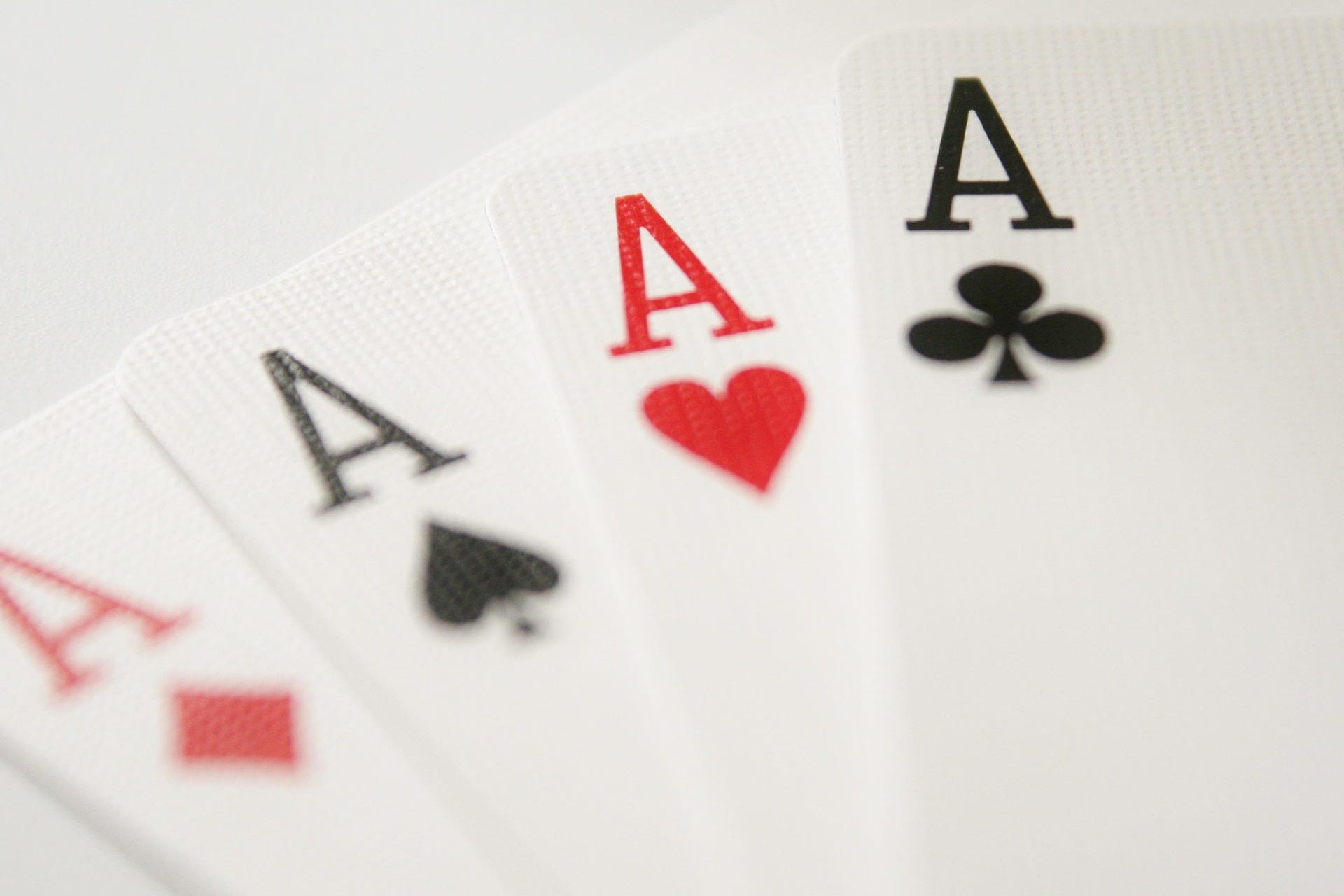
I’ve also long felt that “Twisting the Aces” is more effective as a prelude to the two-by-two transposition. In fact, I don’t think it works that well as a standalone trick or opening effect, for that matter. It functions much better as a “middle piece” between, say, a traditional four-Ace production and Dr. Daley’s Last Trick. I suspect this relates to the unusual nature of the effect from a layperson’s perspective. If they’re expecting you to find a chosen card, having the Aces mysteriously turn face up and face down can be quite disorienting because most people have no frame of reference for this type of magic.
Anyway, I’ll be exploring quite a few tricks in this article—maybe too many—beginning with a three-trick card set called “Duty Aces”.
Duty Aces ✉
This is a set of three card tricks using just four standard Aces and an envelope. The set is unified by a single presentation: the fascinating—and largely forgotten—history of the Ace of Spades and its connection to the British tax system. It tells the tale of the Death Card and how forging the Ace of Spades was once an offence punishable by death! 💀
Against this backstory, the set opens with a fast-paced routine called “Imitation Aces”. The magician displays four Aces of Spades and explains that only one of them is genuine. The three “counterfeit cards” visually transform into the Aces of Diamonds, Hearts and Clubs, leaving the performer with four regular Aces.
After a brief interlude for “Traditional Twist”, a classic handling of Vernon’s “Twisting the Aces”, the set concludes with “Death and Taxes”—a witty presentation of “The Last Trick of Dr. Jacob Daley” that draws the tax theme of the set to its natural, inevitable conclusion.
I created this triplet because, as I’ve already mentioned, I don’t like performing “Twisting the Aces” as an opener, so I needed something else with the four Aces to serve as an introductory effect. “Imitation Aces” works well because it is a quick and visual piece of magic. It also gives the strong impression that you’re using trick cards, so your audience has a natural reason to examine the Aces before you perform “Traditional Twist”. Handing the four cards out for inspection before the reversals take place enhances the impact of the effect, since it removes any possibility that you’re using extra cards (a common accusation from laypeople). The envelope also makes the final reversal of the Ace of Spades more impressive (based on a Darwin Ortiz idea, “Twisting the Case”, from his book Strong Magic). Finally, it clarifies the transposition of the red and black Aces.
Framing all three routines within a single historical narrative turned out to be far more satisfying than I initially anticipated. It gives the three-trick set a strong thematic coherence and a sense of occasion that no single trick could achieve on its own.
Pasteboard Puppies 🐕🐕🐕🐕
This is my favourite way to perform “Twisting the Aces” and “The Last Trick of Dr. Jacob Daley” as a single routine, and my go-to packet trick for a mixed audience of children and adults.
Here’s what happens:
The four Fours become four badly behaved dogs that roll over on command—all except Shamrock, who won’t budge until you offer him walkies. The two black dogs then switch places with the red ones because, as you explain to the audience, they’re “purebred labracadabradors”!
The theme resonates with most audiences, unless you’re performing for a group of cat people, in which case you might want to recast the trick as “Cardboard Cats”! 😻 Cats roll onto their backs when greeting their owners or seeking attention, rather than out of deference like many dogs, so the idea still works.
Here’s what I’ve changed and why. The reversals are triggered by spoken commands rather than Vernon’s twisting action, and Shamrock’s final reversal uses my Tongue Change, set off by the word “walkies!” Because the dogs obey their names and spoken commands, the trick also touches on the concept of kotodama—the ancient Japanese belief that spoken words carry a spiritual energy that can directly shape reality.
More importantly, both tricks now share one coherent story. That matters, because pairing them carries a risk: Dr. Daley’s Last Trick is so strong in effect that it can overshadow the reversals that come before it. A dog rolling over on command gives the audience the frame of reference Vernon’s original lacks, and the premise adds what Eugene Burger described as symbolic and emotional meaning, so the reversals hold their own. (You can learn more about my thinking by reading this blog post.)
Crazy Eights
Here’s another variation of Dai Vernon’s classic “Twisting the Aces” routine using the Eights instead of the Aces. It also combines the four-card reversal with a small-packet Wild Card effect and a brief Ambitious Card sequence.
Here’s what happens:
You introduce the unpredictable “Crazy Eights” and demonstrate their odd abilities by rubbing the Eight of Clubs until it changes into the Eight of Diamonds. Twisting and shaking the packet causes the other Eights to turn face up and transform, while the Eight of Hearts repeatedly teleports from the bottom to the top of the packet. However, the stubborn Eight of Diamonds refuses to turn over, finally flipping when pushed through the packet.
To finish, you twist the packet too many times, accidentally morphing the Eights of Clubs, Hearts and Spades into duplicates of the Eight of Diamonds, before a final twist restores the cards to their proper form.
Here’s what I’ve changed and why. Vernon’s twisting motion often leaves the Aces upside down, which makes it harder to see which card has already turned face up. The Eights read clearly either way, and you spare your Aces the extra wear and tear by not using them.
The Eights also give the trick a compelling hook. They’re the wild cards in the game of Crazy Eights, so the second face-up card can appear as a transformation rather than a reversal. And the stubborn card is now the Eight of Diamonds—which hides a figure of eight between its pips—rather than the Ace of Spades.
The handling stays fairly close to Vernon’s original, apart from the Ambitious Card sequence and my Tongue Change on the final reversal. It’s a fast-paced routine, so I like to follow it with Dr. Daley’s Last Trick to make it last a little longer. There’s also an optional “Dead Man’s Daley” finish that ends with black Aces and Eights, the infamous Dead Man’s Hand. 💀
Vernonesque Card Set #1
This is the three-trick card set I most often perform when someone asks to see some of my card magic, and it puts this edition’s central argument firmly in the spotlight: that “Twisting the Aces” works best as a transition piece between a solid opener—“Underambitious” in this case—and an impressive closer, such as Dr. Daley’s Last Trick. It combines two routines from my regular Ruseletter column, Vernonesque, and one from Packet Trick Paradise.
Here’s what happens:
You perform a small-packet rendition of Ambitious Card, after which the Ace, Two, Three and Four of Clubs are left face up on the table.
Following this, you perform a version of Vernon’s “Twisting the Aces” with the same four cards. During the effect, the Two jumps from the bottom of the packet back to the top, and the cards end in sequential order.
Next, the packet transforms into four duplicate Aces of Clubs, then into the four different Aces. To finish, you perform “Three Times Daley” with the four Aces—a three-phase version of Dr. Daley’s Last Trick, in which the red and black Aces magically change places three times.
Here’s what I’ve changed and why. Performing the three routines as one set follows Vernon’s “Vaudeville Formula” of an opening, a middle and a climax (an application of the three-act structure). The Ace, Two, Three and Four of Clubs carry over from the Ambitious Card opener into “Twisting the Numbers”, and the Two jumping back to the top acts as a fun callback to the first routine. The transformation between the second and third routine acts as a bridge that leaves you holding the four Aces, ready to finish the set by performing “Three Times Daley”. (You can read more about the thinking behind the set in Vernonesque #3.)
Note: To learn Vernonesque Card Set #1, you need to be a paid subscriber to the Ruseletter.
