
Welcome to another edition of Hidden Gems, a regular Ruseletter column in which I unearth long-forgotten magic tricks. I’m doing this to help you cope with the rapid pace of new magic product releases. While I enjoy buying and learning new tricks as much as the next magician, I’m not sure relentless consumption is good for your personal progress or, perhaps, for your soul. And just because something is new doesn’t mean it’s better. Quite the contrary, in fact. I’m hardly the first person to say so. Eugene Burger called it “the tyranny of the new”, and he was writing about the problem in relation to magic as far back as 1989.1
Today, we’re going to take a look at a magic product that was first sold in 2002—over twenty years ago! It’s “Runaway Joker”, a card trick by Peter Nardi, the founder and owner of the UK-based magic shop Alakazam Magic. Alakazam still produce it, so this is one hidden gem you won’t have to hunt for on the expensive second-hand market.
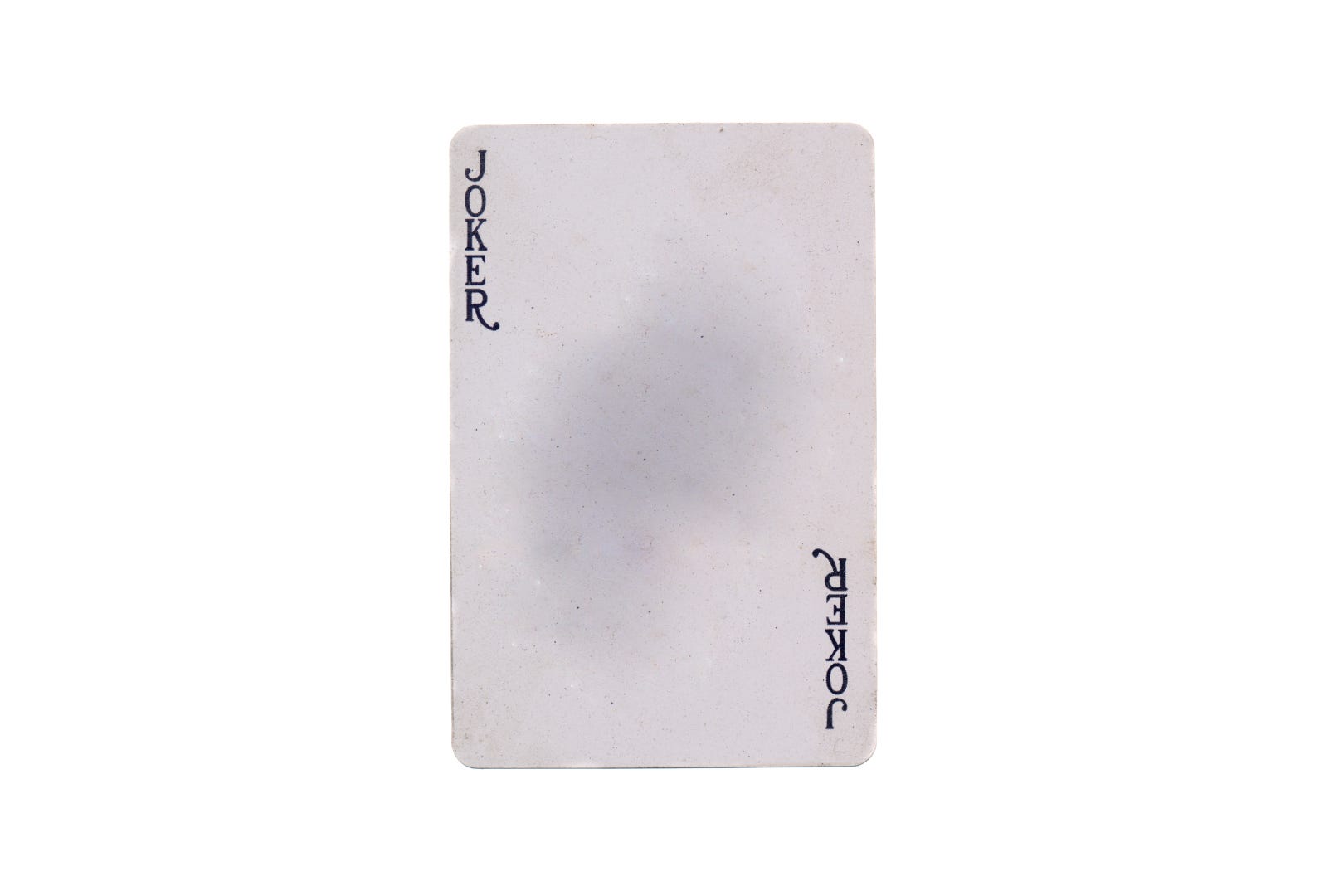
Here’s what happens:
The deck is spread, showing nothing out of the ordinary. The Joker is removed and set on the table. A card is freely selected, and the spectator signs the face of it before cutting it back into the deck himself.
You pick up the Joker and give it a flick. The Joker and his bicycle vanish from the face of the card, leaving the border and the word JOKER behind. The now-empty card is tossed onto the table for examination.
So where did he go? You spread the deck face down and there he is, printed on the back of one of the cards. The card is turned over. It’s the signed selection.
Then one final flick, and the Joker is gone again, leaving your spectator with a clean signed card to keep.
You can watch Peter perform the trick below; the handling is a little different to what’s described above (a little better, in fact):
This is, essentially, Peter’s inventive approach to the Chicago Opener plot or, more accurately, Al Leech’s “A Hot Card Trick No. 1”, circa 1950. There are quite a lot of things I like about it.
The handling is efficient and doesn’t call for any particularly difficult sleight of hand; it uses Marc DeSouza’s Shapeshifter Change and a double turnover, and that’s about it. (Peter also uses a Top Change in the video demo above, but that’s an optional extra. You could also substitute a Twirl Change for the Shapeshifter Change if you have difficulty with that particular move.) More importantly, the Joker’s appearance on the back of the chosen card gives you an excuse to stop and let a spectator touch the ink (to make sure it’s dry and really printed onto the card). This moment makes the subsequent double turnover easier to execute in a relaxed, carefree manner, which is critical in this type of routine.
However, the best thing about “Runaway Joker” isn’t the handling; it’s what it does to the structural weaknesses of the Chicago Opener plot.
In “Spill the Tea: Is Chicago Opener a Good Trick?”, I set out three of them. Eugene Burger identified the first two: the double lift happens at the worst possible moment—when everyone is looking at the card—and the second phase teaches an observant spectator how the first phase works. I added a third of my own: the two cards are chosen inconsistently, and the second selection never feels as fair as the first.
“Runaway Joker” dispenses with that third weakness entirely. There’s only one selection. It’s free, it’s signed, and the spectator loses it himself by cutting it into the deck (incidentally, I wouldn’t bother having the card signed because I like the idea of presenting the whole sequence as a “surreal mirage”, with no evidence of the magic left behind). Pop Haydn engineered an elegant “subroutine” into his signature trick “Chicago Surprise” to solve this problem. Peter simply sidestepped it by not including a second card.
In the standard handling of Chicago Opener, the odd-backed card sits on the table, out in the open, like a blinking light leading people directly to the method, which is precisely why my advice is to pocket it and move on quickly to something else. Here, the trick tidies up after itself. The final vanish removes the incriminating evidence. Getting rid of the gaffed card isn’t something you have to hide—it’s the last magical beat of the routine.
Peter’s approach also answers Tom Stone’s objection (again, see “Spill the Tea: Is Chicago Opener a Good Trick?” for full details). Tom dislikes the “gotcha” element of Chicago Opener and its well-worn magician-in-trouble premise. “Runaway Joker” dispenses with this tired trope entirely. Nobody has lost anything, nobody is pretending to have failed, and the ending closes a loop rather than springing a trap.
Too often, when magicians perform the Chicago Opener, there is no rhyme or reason for the back of the card to change colour (beyond helping the magician locate the chosen card). In “Runaway Joker”, the Joker is doing exactly what you’d expect a Joker to do: misbehave!
Which brings me to my final reason for recommending the trick. I love tricks that use the Joker, and I have plenty in my repertoire that use one, two, three, and even four of them—you’ll find quite a few of them published on my blog. Because “Runaway Joker” begins and ends with an ordinary, examinable Joker, I can see all sorts of opportunities to use one of those other tricks as a lead-in to “Runaway Joker”.
I still don’t think Eugene Burger would have performed this routine. He eliminated every trick requiring a double lift or turnover from his working repertoire, and no amount of clever construction would have talked him round. The move is still there, at the moment of maximum attention, and although Peter delays it and lets the tension drain away first, the objection still stands. But of the three weaknesses mentioned, Peter’s trick answers one of Eugene’s outright, sidesteps mine completely, and also fixes Tom Stone’s main objection to the plot.
Not bad for a trick that’s older than some readers of the Ruseletter!
“Runaway Joker” is available directly from Alakazam Magic or your favourite magic dealer. I think it’s a seriously underrated classic card magic effect. If you’re looking for a fun, memorable alternative to Chicago Opener, then I can’t recommend it highly enough. 🃏
Disclosure: This edition of Hidden Gems was not sponsored in any way by Peter Nardi or Alakazam Magic. It reflects my own thoughts and feelings about the product. I just thought I’d better make that perfectly clear.
Yours Magically,
Marty
Eugene Burger, “The Tyranny of the New,” The Experience of Magic (Kaufman and Greenberg, 1989), pages 45–48.