
Welcome to the February 2026 Monthly Update. By early February, approximately 80% of people have already abandoned their New Year’s resolutions. The second Friday of January has even been dubbed “Quitter’s Day”.
My solution is simple: I don’t set resolutions in January. Instead, I delay making them until the Chinese New Year, which falls on the new moon between 21 January and 20 February each year. 🌚 This year, it fell on 17 February.
I like this approach for three reasons. First, it gives you time to settle into the New Year before making any concrete plans. Second, aligning your intentions with the first new moon of the year feels more appropriate—and, well, magical. Third, the Chinese New Year is celebrated for fifteen days, from the first day of the lunar calendar through to the Lantern Festival, giving you an extended window in which to commit to the changes you most want to make.
This year also carries an added layer of significance for anyone, like me, with a love of folklore: 2026 is the Year of the Fire Horse. 🔥🐎 Appearing only once every sixty years—the last time was 1966—the Fire Horse is widely considered the rarest and most intense animal-element combination in the Chinese zodiac. Fire Horses are said to be charismatic, bold and passionate: qualities any magician, amateur or professional, would do well to cultivate. Whether or not you put any stock in such things, it feels like an auspicious year to raise our magical game.
So, even though Chinese New Year has passed, you still have time to make some magic-related resolutions (the big secret is that you can make habit-change promises to yourself at any time during the year). Here are my main ones for 2026:
Build the magic den of my dreams: a proper, dedicated space for creating, practising, rehearsing and sharing my magic.
Say yes to more performance opportunities, however small.
Deliver Developing Daley, Volume 1—no more delays.
That second resolution is the one I suspect many of you will share. It’s easy to keep learning, keep practising and keep telling yourself you’re not quite ready yet. James Clear, whose work on habits I’ve returned to many times in this newsletter, puts his finger on why this resolution matters:
“Learning more will increase knowledge, but only attempting more will reduce fear. The more you try it, the less you will fear it.”
It’s a reminder that no amount of practice in front of a mirror can substitute for standing in front of real people and performing a magic trick for them. Which brings me to this month’s article.

Recently, I shared two new romantic card tricks inspired by Jane Austen’s novels, which got me thinking about a question recently discussed on The Magician’s Forum: Do Women Really Hate Card Tricks? What started as a few short paragraphs has somehow morphed into a five-thousand-word theoretical essay on gender politics in the world of magic! Enjoy.
Pride, Prejudice & Pasteboards: Do Women Really Hate Card Tricks?
Reading time: 20 minutes
In the discussion, it was noted that Joel Bauer—a successful American magician, trade-show performer and self-proclaimed “infotainer”—believes that many women dislike playing cards. In a recent episode of The Magic Word Podcast with Scott Wells, he made his opinion on the matter abundantly clear (the emphasis is mine):
“Women don’t particularly like cards, and magicians don’t understand that. But if you’re gonna use a deck of cards, use a Tarot deck. They’re interested in that. OH YEAH. It’s totally different, And if you’re gonna do a haunted pack, do a haunted Tarot pack. And tie it in and make it personal. I’m not telling them to be Bizzare. I’m saying you gotta care about the male and female. They’re different.”1
I found this somewhat sweeping statement at odds with my own, admittedly more limited, experience. On the whole, I’ve always found that women are more receptive to magic, wonder and astonishment than the average man. While I don’t disagree with his general advice to make your magic more personal, I think his central premise—that women don’t like cards, and by extension, card tricks or magic in general—doesn’t hold up.
Joel isn’t the first high-profile magician to make such a polarising statement. Writing in his Genii column, “The Vernon Touch”, the Canadian-born close-up maestro Dai Vernon expressed a remarkably similar view as far back as October 1968:
“Talking about doing magic for women, I have lived a long time, and I don’t think really, honestly, I ever met a woman who likes magic… who REALLY likes magic. They’ll watch a card trick to please some guy, but I don’t think they really enjoy watching a card trick.”2
Later in the same column, he added:
“By the way, if there are any normal girls who refute this statement, I hope you’ll write in and let me know.”
The postbag, it seems, was more instructive than Vernon had anticipated. By December 1968, he was already backpedalling a little:
“I was surprised, and at the same time enlightened, by the fact that to date, I have heard from at least three girls who told me that they simply love and adore magic. These may be exceptions to the rule… they are really exceptional girls. I still am not firmly convinced yet. I’ve only known three or four girl magicians like Lady Frances and Celeste Evans. They like magic because they make a living from it. But I mean the average magician’s wife who has to put up with this sort of thing. They learn to hate it. ”3
In 2026, the condescension is jarring and, if I’m honest, a little cringeworthy. Back then, women who liked or even dared to perform magic were not magic enthusiasts or fellow performers—they were anomalies, curiosities, and exceptional enough to write home about. It is worth remembering, though, that Vernon was performing and writing at a time when such attitudes were both tolerated and largely invisible, even to those who held them. He was a product of his era, but at least he was willing to be persuaded.
And persuaded he eventually was. Writing years later, in 1977, from his perch at the Magic Castle, Vernon quietly reversed course:
“In my past days I never felt that the girls especially enjoyed watching a magician but I have changed my thinking since being here. Of course, any effect with a fortune-telling atmosphere to it is doubly enjoyed by the ladies.”4
It is a small yet significant concession. But it matters because what changed Vernon’s mind wasn’t an argument, a theory or a sudden epiphany. It was simply watching women enjoy magic night after night at the Magic Castle.
With this historical example in mind, I can’t help but think that Joel’s general performance advice is right, but for entirely the wrong reasons. You only have to read Jane Austen’s novels to appreciate that women have enjoyed playing cards as a social pastime for centuries. It follows, therefore, that they should also enjoy card magic.
It isn’t the cards women dislike—it’s the chauvinistic performer who treats them as a prop, or worse, as an unpaid magician’s assistant. The problem, in other words, isn’t the pasteboards. It’s the ego behind them. They don’t hate magic—they hate male magicians. And who can blame them when they behave in this way?
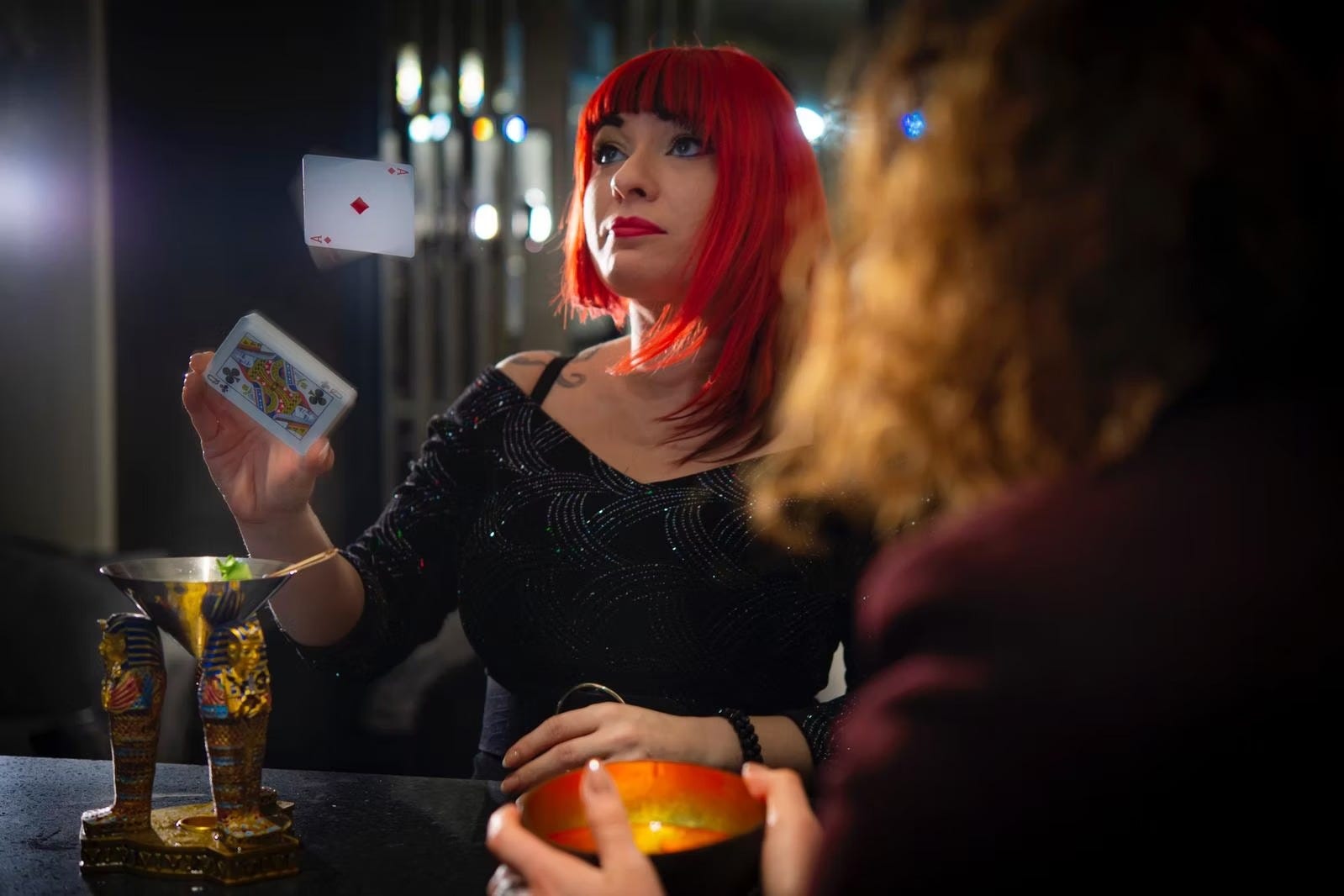
Laura London—Inner Magic Circle member, recipient of a standing ovation at the Magic Castle, and one of the finest card mechanics working in Britain today—puts it just as bluntly. Asked for her best advice on approaching strangers and getting them to like you, she was unequivocal:
“Don’t approach people and be arrogant. People don’t like that. People certainly don’t like you telling them that you are some mystic being, either. We’re in [the modern era] now, and nobody believes that we can actually do real magic, so don’t treat your audience like idiots… like fools.”5
This idea has percolated in magic theory circles for some time. In an October 2003 discussion on the long-dormant Usenet group alt.magic.secrets, Hawaiian magician Jim Kawashima reported that fellow illusionist John LeBlanc had relayed a remark attributed to Max Maven: that magic is fundamentally a “power thing”, and that women had, until relatively recently, not been encouraged to be part of the “power sphere”.6 (I cannot verify that characterisation in any published source, and it’s at least two degrees removed from Maven himself, but anyone familiar with his thinking will find it entirely plausible as something he might well have said.)
Detectives & Dreamers
To understand why the ego-driven approach to card magic fails women so consistently, it helps to examine what it does to any audience.
In his essay “Tough Customers” in The Books of Wonder, Volume 1, Dutch-born master magician Tommy Wonder identified the problem with characteristic insight. The magician who presents his work as a challenge—however subtly or unconsciously—pushes his audience into a role they were never meant to play: the detective.
“It is highly desirable not to push spectators into the role of detectives on the trail of your secrets, because it can make your job harder; and, what is more important, it can prevent your audience from experiencing other elements of your performance, elements capable of far greater entertainment potential than mere puzzlery can offer. Good magic has so much more to give than puzzlement.”7
By definition, the detective is adversarial. He is looking for the trick, the method, the moment of deception. He is not there to be moved, delighted, or transported. He is there to catch you out. And the magician who presents his performance as a puzzle, consciously or not, has invited him in and handed him a deerstalker and magnifying glass! 🕵️ (It should be noted that what Tommy Wonder isn’t saying is that we should attempt to eliminate the puzzle element from our tricks entirely, only that we shouldn’t treat them as puzzles to be solved when presenting them to an audience.)
Here is where the question of gender becomes directly relevant, and where we need to be careful, because the argument is easily misread. The claim is not that women are incapable of analytical thinking, or that they are more credulous or more easily impressed than men. The claim is considerably more surprising: that the detective role, as Wonder describes it, is one most women are considerably less inclined to adopt than most men. This difference is cultural rather than innate. Let me explain.
Most male magicians were introduced to magic as young boys, drawn in by the very puzzle element that makes card magic so alienating when it goes awry. The astonishing Ace Assembly, the baffling Two-Card Transposition, or the Card to Impossible Location that defies all logic—these were the things that first captured their imagination. That early enchantment leaves a deep mark, shaping not only how they perform magic but also what they believe magic is: a challenge, a contest, a demonstration of their superior knowledge. The detective is not the enemy to be disarmed. For many male performers, he is, at some level, their ideal audience—because he represents the boy they once were.
Women, on the whole, approach magic differently. They tend to inhabit the role of the dreamer. Without that early card-trick conditioning, they respond less to the puzzle of a magic trick and more to the experience itself—the narrative, the emotional hook, the sense that something mysterious is being shared. They are, in Wonder’s terms, natural dreamers rather than default detectives. And the performer who’s never questioned his boyhood assumptions about what magic is (or should be) will, almost inevitably, fail to meet their needs.
It would, however, be a mistake to push this argument too far. The detective role is not exclusively male. Nor is the dreamer always female. Mark Leveridge—one of Britain’s most experienced close-up professionals and the author of the long-running Chatter blog on magic—discussed this very issue in an August 2004 piece on precisely this subject. He described a woman who had booked him for a corporate dinner. When he approached her group, she promptly told him she couldn’t stand magic and slipped away. Halfway through the meal, she returned; her friends were worried he would skip their table because of what she had said. He went and performed at the table. She watched. Her verdict: “Oh, it drives me crazy because you just can’t see how he’s doing it!” Leveridge diagnosed her as a spectator so fixated on the how of magic that she found it harder to enjoy it for what it is actually meant to be (or, as Mark puts it, the “how” versus the “wow”).8 She was not immune to wonder. She was a frustrated detective and, as Leveridge pointedly noted, a self-identified magic-hater who had booked a magician for her own event.

The same culture that alienates women in the audience also shapes the experience of those who wish to perform magic. Megan Swann—the first woman to serve as President of The Magic Circle and the youngest person ever to hold that office—has described arriving at her first magic club meeting as a ten-year-old:
“As 10-year-old me, little 10-year-old me, quite shy, turning up and seeing this room full of 80 boys who seemed like giants… it was a bit scary. It was a bit of a shock. Fortunately another girl did turn up… and I don’t know quite what would have happened if she hadn’t, because I think 10-year-old me would have been too scared. I probably wouldn’t have come back.”9
Laura London tells a similar story. Walking into the Magic Circle at eighteen, she was about to turn around and leave the profession entirely:
“I walked in and was about to walk out and never come back… it wasn’t that it wasn’t particularly friendly, it’s just I was really out of place.”10
She stayed. She went on to become the youngest ever female member of the Magic Circle, the first elected female Chair of the society, and a Member of the Inner Magic Circle with Gold Star, the club’s highest honour. She has also appeared on Penn & Teller: Fool Us and performed for Her Majesty the Queen at Buckingham Palace. Yet the fact that two of British magic’s most distinguished female practitioners describe the same instinct—to walk away from a room full of male magicians—tells us something important about the culture that room reflected.
Swann did come back, too, of course, and rose to lead the Magic Circle. But most ten-year-old girls, confronted with that room, would not. And the boys who filled it grew into the magicians who now wonder why women don’t enjoy their dull card tricks.
The conditioning runs in both directions, and its consequences are long-lasting. Swann herself is a case in point. “I learned quite soon that card tricks really bored me,” she admitted in the same interview. “I just don’t like card tricks... maybe it’s just from those early days seeing so many card tricks, often done quite badly—maybe it put me off.”11 Here, in one sentence, is the entire arc of this article compressed into a single confession: a woman who loves magic, has devoted her professional life to it, and has risen to lead the most prestigious magical organisation in Britain, has been put off card tricks for life by a succession of thoughtless male performers.
Don’t worry, this is not a counsel of despair. It is, if anything, a golden opportunity. The dreamer is not a lesser audience than the detective. She’s a better one: more open, more responsive, and more willing to participate. The only thing standing between her and a transformative experience of magic is a magician willing to set aside his ego and offer something worthy of the spectator’s wildest dreams.
Pride Before a Fall
So, what does all this have to do with classic romantic literature? Jane Austen is precise about what she means by pride. Mr Darcy’s failing isn’t simple arrogance—it is the complex conviction that his superior knowledge and judgment make him above the need to please others. He doesn’t perform for anyone’s approval. He condescends. And it’s that pride that makes him initially repellent to the very person he most wants to impress in the world.
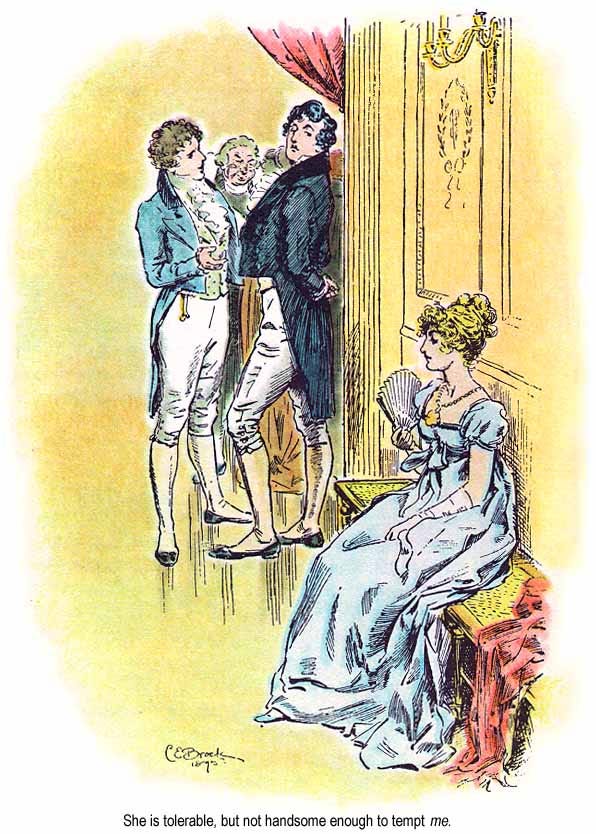
The parallel with the ego-driven magician is remarkable, almost uncomfortably so. The performer who frames every trick as a puzzle is destined to disappoint. Hoarding his secret knowledge like a private currency, he isn’t performing for the people in front of him. He is performing above them. They are not participants in something wonderful. They are witnesses to his smug superiority. Maven’s “power thing” is, at its root, nothing more than Darcyian pride in a badly fitted dinner jacket doing condescending card tricks.
But here is where Austen’s novel offers much more than a useful metaphor. Mr Darcy doesn’t remain proud. He is humbled—not by defeat, but by the gradual recognition that his pride has made any opportunity for genuine connection impossible. He has to dismantle something fundamental in the way he presents himself to the world before Elizabeth can see him clearly. And only then, stripped of the performance of superiority, does he become someone worth knowing and worthy of her love.
The magician faces exactly the same choice. The tricks don’t change. The methods don’t change. What changes is the relationship the performer offers to the people in front of him—and whether it’s one of condescension or of shared wonder.
So, if ego is what drives the prideful approach to performance, prejudice is what that ego does to the women in the room. Surprisingly, it operates, more often than not, without the performer even noticing…
Performance and Prejudice
I’ve been to enough magic conventions to recognise a troubling pattern that persists to this day. When women are present, they’re almost always the first to be selected as “volunteers”—again and again, by performer after performer. This is particularly obvious when very few women are in attendance, as the same two or three female faces appear on stage repeatedly. What seems like a natural choice—it’s true that women are often warmer, more expressive, better at playing along—looks very different from the audience’s perspective. She’s not being chosen because she’s valued. She’s being chosen for her utility.
I witnessed this at close quarters at one such convention, seated beside a female companion (whom I’d met and befriended earlier that day). A well-known and experienced American cardician performed for us (who shall remain nameless). She was asked to sit beside him and be his spectator. He was technically brilliant.
However, he was entirely oblivious to the negative effect his actions were having on her emotional state. The way he handled her involvement, the casual assumptions he made about her role, and, in particular, the chauvinistic jokes he carelessly made at her expense all indicated that he was performing at her, not for her. When she eventually returned to her seat, she was visibly flustered, red-faced, upset, as well as a little angry at his treatment of her. He never even noticed.
Mark Leveridge identified the same pattern as far back as 2006. Writing at a time when the magic world was far less inclined to discuss such matters openly, he observed that at any major convention, if there is a single woman in the audience, almost every performer who needs an assistant will select her. He was candid about the likely explanation: either it is a male ego thing, or a condescending assumption that a woman is less likely to be a fellow magician and therefore more likely to respond well. Either way, he found both explanations wanting. More pointedly, he noted that women attending magic events still routinely endured sexist jokes, wisecracks and thinly veiled innuendo. He appealed directly to performers to treat female audience members with the respect that might encourage rather than repel them.12 Very good advice indeed.
This gap—between what the performer believes he is offering and what the woman in front of him is actually experiencing—is prejudice in its most precise sense. Not malice. Not even indifference. Simply a judgment formed in advance, before a single card has been selected or silver coin produced: she is here to assist me, to look pretty, to react favourably, to be charmed. To make me look good. Her role has been assigned. And no amount of technical brilliance will compensate for the fact that she has been told, wordlessly but unmistakably, that her place in this exchange is a subordinate one.
Megan Swann has spoken about this assumption with the authority of someone who has encountered it repeatedly, from both sides of the table. Speaking on Craig Petty’s Talk Magic Podcast in 2021, she described the default expectation that greets women in magic circles:
“Just from my experiences being out in the public and even around other magicians, you almost assume that a woman doesn’t do magic—or you assume that they’re the assistants. Because there’s not been that many female role models over the years... Maybe if you go back and look at how women were persecuted as witches, maybe that’s had an effect. And the fact that... once upon a Shakespearean time women couldn’t even go on stage. There is a long history of women not being involved in the performing arts.”13
It’s a prejudice she had encountered long before she reached the upper echelons of the Magic Circle. In an earlier interview, she described the experience of attending magic events as a young woman:
“It’s a pet hate of mine when I meet new people at magic clubs or conventions who first assume I am not a magician, clearly because I am a woman. I get asked if I’m there with someone else, or if I want to see a ‘really simple card trick’ that even I could do.”14
The prejudice, then, is not merely personal. It is historical and institutional. Like all prejudice, however, it flows in both directions.
Just as Elizabeth Bennet’s prejudice against Darcy is a direct response to behaviour she has observed and reasonably generalised, the scepticism many spectators bring to a magic performance is a direct response to a performance culture that, too often, has given them good reason to be wary.
Craig Petty, one of the UK’s most prominent working magicians, has written about this in his trademark no-nonsense style. When an audience member tells him they hate magic, he doesn’t take it personally—because he understands exactly what they mean: “they have seen a cheesy magician with no skill or social skills and have judged all magicians on one performance.”15 The woman who greets you and your tricks with hostility isn’t being unreasonable. She has simply been here before—and the last time, she didn’t enjoy it.
Tommy Wonder identified the same dynamic from the performer’s perspective, with considerably greater analytical precision. In his essay “Tough Customers”, he observed that some spectators arrive already locked into the detective role, not because they are naturally adversarial, but because they have been conditioned:
“Some people are conditioned, have it engraved in their mind, that when they see a magician, they should try to determine how the tricks are done. The moment they know you are a magician, they throw themselves into the role of detective.”16
This is prejudice in its purest form and, like all prejudice, it is not irrational. It is the entirely logical conclusion of accumulated experience. The question Tommy Wonder asks—and the question this article has been pursuing from the beginning—is what the performer can do to dismantle it. His answer is unambiguous:
“If you can transport people out of the role of detective or, better yet, prevent them from entering into that role, you will have done them a good service, since you can then offer them something of much greater interest.”17
The responsibility, in other words, lies with the magician, not the audience. The prejudice flowing back towards the performer is an unforgiving mirror. What it reflects, whether beautiful or ugly, depends entirely on the magician and, ergo, the performance culture that created it.
The Relationship is the Remedy
The remedy to both pride and prejudice in performance is not a different trick, method or technique. It is a different relationship.
Laura London states the principle with the ease of someone who has understood it for years:
“It’s not about the magic, really; it’s about you. If you walk up to a group of people and they like you instantly, then what you do doesn’t matter as long as it’s good and it is entertaining… anybody can learn a trick… you can go into a shop right now, you can buy some really strong great magic, you can learn it in a few days. But if you can learn how to perform it well, that’s really the question… it’s all about presentation.”18
Eugene Burger—one of the most thoughtful performers and writers the magic world has ever produced—put it much the same way, summing it up succinctly in a single sentence:
“Presentation is that point where you put yourself into your magic.”19
It sounds simple. In practice, it is a radical reorientation of the usual performer-participant relationship. The magician who puts himself into his magic is no longer operating from a position of superiority and self-assured smugness. He offers something of himself: his imagination, his sense of wonder, his emotional intelligence. The transaction is no longer adversarial. It is, in the fullest sense, an invitation to astonishment.
Burger developed this idea further in Magic and Meaning, the remarkable book he co-wrote with Robert E. Neale, arguing that card magic is not fundamentally a puzzle to be solved or a demonstration of skill to be admired. Card tricks performed without meaningful presentation, he suggested, fail to engage the audience at the level of their deeper emotional lives—their hopes, fears and dreams. The difference between a “card trick” and “card magic” is the difference between watching and feeling.20
Mark Leveridge reached the same conclusion from a different direction—through a humbling personal experience rather than theory. Early in his career, he entered a close-up competition at a regional convention, confident that his technically accomplished act would carry the day. He lost decisively to a performer whose magic was considerably weaker, yet whose ability to make the audience feel involved and entertained was in a different class. The lesson he drew from that defeat stayed with him: that what an audience ultimately measures is not the quality of your sleight of hand but the quality and depth of the experience you give them.21
Reading all of this in light of everything Vernon and Bauer got wrong, it is clear that women don’t lack the capacity for wonder. They lack the patience for ego. Offer them a trick dressed up as an intellectual challenge—a puzzle designed to make them feel foolish—and, of course, they will disengage. Offer them, instead, an emotional experience that connects with their dreams, hopes, and sense of the mysterious. The response will not be different in degree. It will be different in kind.
It turns out this is not a modern insight. It is not even a particularly radical one. Jane Austen knew it two hundred years ago, and so did Dai Vernon in his later life. The question is whether we, as performers, are willing to act on it.
The presentation that achieves this doesn’t need to be Regency-themed, romantic, or literary. It needs only to offer the spectator something worth feeling—a story, an emotion or a fresh perspective. The theme is, of course, interchangeable. The principle is not.
Which brings me back to the pasteboards.
Two Austen-Inspired Card Tricks
Theory, of course, is only as useful as what you do with it. So let me show you what this looks like in practice. Recently, I’ve been assembling what I’ve come to call “conversational card magic” routines—tricks that can be woven seamlessly into casual conversation, making it easier for amateur magicians to create opportunities to perform more meaningful magic in everyday situations.

Here are two romantic card tricks inspired by Jane Austen’s classic works. The suggested presentations make it easier to transition into a performance when discussing this topic with a friend, colleague, or even a stranger at a bus stop! Asking someone whether they’ve ever read any of Austen’s books is perfectly normal (asking them to pick a card is not). This then gives you the opportunity to talk about the many and varied card games her characters play in her novels, opening up the opportunity for a card magic performance.
“Perfect Partners” is my full-deck handling of Cameron Francis’s “Coupling”, dressed in all the Regency finery of a Jane Austen character. Two spectators are invited to partake in an ancient “love ritual” and, after a sequence of apparently fair choices, find themselves holding the King and Queen of Hearts. No one selects a card. No one is put on the spot. No one is made to feel foolish or singled out. The routine has a strong romantic hook, a surprising kicker ending drawn from the Regency era card game of whist, and—crucially—it gives the two spectators all the glory. The performer is not the hero of this story. They are.
“In Want of a Wife” does the same for a single spectator—ideally, though not exclusively, a woman—placing her at the centre of a romantic narrative rather than at the receiving end of a magical how-did-they-do-it. The effect, a treatment of Hofzinser’s Royal Marriages, unfolds in four distinct phases, each seemingly more impossible than the last, as the Kings and Queens find their partners through a playful Regency courtship ritual complete with Austen quotations. The method involves the Elmsley Count, a double lift and an Under-Down Deal—none of which are beyond the reach of any intermediate card worker. The mechanics, in other words, are modest. The emotional impact is not.
What both routines have in common—and what I’d encourage you to look for in any trick you’re considering adding to your repertoire—is that the presentation does the ego-work for you. When your hook is a Regency love story, there’s no room for the performer to position himself as the cleverest person at the table, because cleverness isn’t the point of a love story. The spectator isn’t being challenged, tested, or managed. She’s being invited into something. That shift in framing changes everything about the dynamic between performer and participant. It opens the door to the kind of natural, unhurried conversation that makes card magic feel less like a technical demonstration of skill and more like a shared experience. The trick becomes a reason to talk rather than a barrier to conversation.
This is what I mean by conversational card magic. Not tricks that merely have words attached to them, but tricks whose very structure encourages the performer to listen as well as to speak—to be present with the person in front of him rather than overly focused on the execution of the next move. Austen’s novels work the same way: the card games her characters play are never really about the cards. They are about what the cards allow people to say to each other.
These two examples show that almost any card trick can be presented in a way that makes it more appealing to women. While not all women enjoy classic romantic literature, a Regency theme is more likely to resonate with a female audience than a standard gambling-themed trick, such as an Ace-cutting routine. The problem was never the pasteboards. It was never even the women. It was the story we chose to tell with them—and whether that story had room to include the people sitting across the table from us.
Conclusion
So, do women hate card tricks?
Joel Bauer thinks so. Dai Vernon thought so for a large portion of his life. Many of the contributors to alt.magic.secrets thought so, some with a fervour that said considerably more about themselves than about women.
The evidence, I would suggest, points elsewhere—and it comes from women themselves.
Megan Swann was nearly frightened away from magic at ten by a roomful of boys who didn’t know she existed. Laura London walked into The Magic Circle at eighteen and was on the verge of walking straight back out because she didn’t feel she belonged. Thankfully, both women stayed. Both went on to lead distinguished careers. But here is the question worth pondering: how many didn’t? How many women endured one too many card tricks done badly, performed by one too many men who treated them as props rather than participants, and simply decided that magic wasn’t for them?
Women don’t hate card tricks. They hate being condescended to. They hate being managed, manipulated and assigned a supporting role in someone else’s ego-trip thinly disguised as a magic trick. They hate the bad jokes, the sexist patter and the boring presentations. And they are entirely right to hate all of these things—because this isn’t what card magic, any magic, should be like.
What women respond to—what, if we’re honest, everyone responds to—is a performer who offers something beyond his own cleverness. A performer who understands that the trick is not the be-all and end-all; that the presentation matters; and that the person sitting across the table from him is not an obstacle to be overcome but a guest to be welcomed. A man who has, in short, grown up and no longer acts like a boy.
Austen understood this. Hofzinser understood this. Eugene Burger spent a lifetime trying to help the rest of us understand it. Laura London and Megan Swann have been demonstrating it—not in theory, but in practice, in real rooms, before real people, night after night.
Finally, I’d like you, dear reader, to consider the following tongue-in-cheek aphorism:
It is a truth universally acknowledged that a magician in possession of a good trick must be in want of a great presentation.
All the cards are on the table. The question is simply whether we’re willing to set our pride and prejudice aside long enough to find one.
Three Videos Worth Watching 📼
And, as usual, here are three videos worth watching.
Learn Josh Burch’s Three Queens Card Trick
Learn a fun, self-working card trick from Eric Tait and Penguin Magic. 🐧 The method is a good one, but the trick needs a better presentation than the one shown in the video.
If you’re a fan of the 2002 film Minority Report, starring Tom Cruise and directed by Steven Spielberg, you could use a red Queen and the two black Jacks to represent Agatha, Arthur, and Dash—the “precogs” in the film. Somehow, they’re able to predict the future (the number of cards left in your hand).
Learn Josh Burch’s “Pincode” Card Trick
Here’s another solid self-working trick in want of better presentation. Josh Burch employs a “pincode” premise to justify the method’s mathematical basis, which is probably a stronger way to present this than Eric’s suggestions in the video (though his teaching is excellent). The method is, perhaps, more intriguing than the effect. It is based on Jim Steinmeyer’s “The Nine Card Problem”.
If you want to learn more about the underlying mathematics—it’s an application of the COATing (Count Out And Transfer) principle from Colm Mulcahy—I recommend reading this article and watching this video. A better trick for three participants using the same principle is Diamond Jim’s Insanely Easy Card Trick.
Ryan Pilling’s Magic Homework #8
Finally, here is the latest video in Ryan Pilling’s fantastic Magic Homework series. Derek Dingle’s “Too Many Cards” is very similar to a trick I’m working on at the moment—Larry Jennings’ “Ambitious Classic”—so I really enjoyed this episode. I think you will too.
You can watch all episodes of Ryan’s Magic Homework on his Tips & Tricks for Magicians YouTube channel.
I hope you enjoyed this month’s long-form essay. If you find this format enjoyable, I might continue writing more. Please let me know by replying to this email or posting a comment in the Substack section.
Yours Magically,
Marty
Joel Bauer, “951: Joel Bauer—Infotainer”, The Magic Word Podcast, hosted by Scott Wells, 23 January 2026, podcast, 56:43, https://youtu.be/rvNRaekTh5c?si=dK6W54VGPvyd9LGq&t=3383.
Dai Vernon, “The Vernon Touch”, Genii: The Conjurors’ Magazine, October 1968, 63.
Dai Vernon, “The Vernon Touch”, Genii: The Conjurors’ Magazine, December 1968, 152.
Dai Vernon, “The Vernon Touch”, Genii: The Conjurors’ Magazine, January 1977, 19.
Laura London, Talk Magic, Episode 107, hosted by Craig Petty, 12 October 2021, 13:50, https://youtu.be/GhoF9ntyEy4?si=Fw6HbHxGnyw828ve&t=830.
Jim Kawashima, alt.magic.secrets, 13 October 2003. Kawashima attributes the remark to John LeBlanc, who relayed it from Max Maven.
Tommy Wonder, “Tough Customers”, The Books of Wonder, Vol. 1 (Seattle: Hermetic Press, 1996), 35.
Mark Leveridge, “The Secret Isn’t Everything”, Chatter, vol. 12, no. 12, August 2004.
Megan Swann, Talk Magic, ep 68, hosted by Craig Petty, 4 July 2021, 18:14, https://youtu.be/eX_iROJC_W4?si=bw-HbF9AOQT9W56X&t=1094.
London, Talk Magic, ep. 107, 06:05, https://youtu.be/GhoF9ntyEy4?si=X2a7VszYBFnvykJ8&t=365.
Swann, Talk Magic, ep. 68, 09:54 and 47:07, https://youtu.be/eX_iROJC_W4?si=g2BmYd8OrhsbtRNV&t=594 and https://youtu.be/eX_iROJC_W4?si=NnOnRJt6NjLqA2cf&t=2827.
Mark Leveridge, “Where Are All the Female Magicians?”, Chatter, vol. 14, no. 10, June 2006.
Swann, Talk Magic, ep. 68, 19:51, https://youtu.be/eX_iROJC_W4?si=rTczMFrXcln4mTWV&t=1191.
Megan Swann, interviewed by sciencemagician, Words on Wonder, 26 November 2018, https://wordsonwonder.com/2018/11/26/interview-45-megan-swann/.
Craig Petty, “Why Do People Hate Magic?”, Slightly Unusual (blog), 10 March 2018, updated 11 July 2024, https://www.slightlyunusual.co.uk/single-post/why-do-people-hate-magic.
Wonder, “Tough Customers”, 35.
Ibid.
London, Talk Magic, ep. 107, 10:40.
Eugene Burger, Mastering the Art of Magic (Washington, DC: Richard Kaufman, 2000), 115.
Eugene Burger and Robert E. Neale, Magic and Meaning, expanded ed. (Seattle: Hermetic Press, 2009), 127.
Mark Leveridge, “Magic As Entertainment”, Chatter, vol. 18, no. 6, February 2010.
Thank you Marty for this essay. It matters so much how we treat our spectators and assistants - particularly our ladies. Some very helpful insights for me to ponder.
Magic that moves emotions well is far and away the best and most impactful to perform.
Just been to the Christian Magicians UK Conference and both styles were on display. Sometimes it is unconscious and if the person is willing to learn then can be confronted easily and gently.
As I said - much to think about .....
Many of my magician friends think that my wife hates magic. One of them decided to confront her head-on at a dinner party.
“You don’t come to our events very often. Is because you hate magic?”
She paused for a moment and said, “I don’t hate magic; I hate BAD MAGIC!”