
Welcome to the (slightly late) April monthly update for Marty’s Magic Ruseletter. In this edition, I cover one of my favourite magic podcasts, along with a few ways to use AI in your magical studies, and the “square hole” illusion. I’m also sharing two new tutorial links: one for everyone, and another for paid subscribers.
In the words of a famous Italian plumber, “Let’s-a go!”
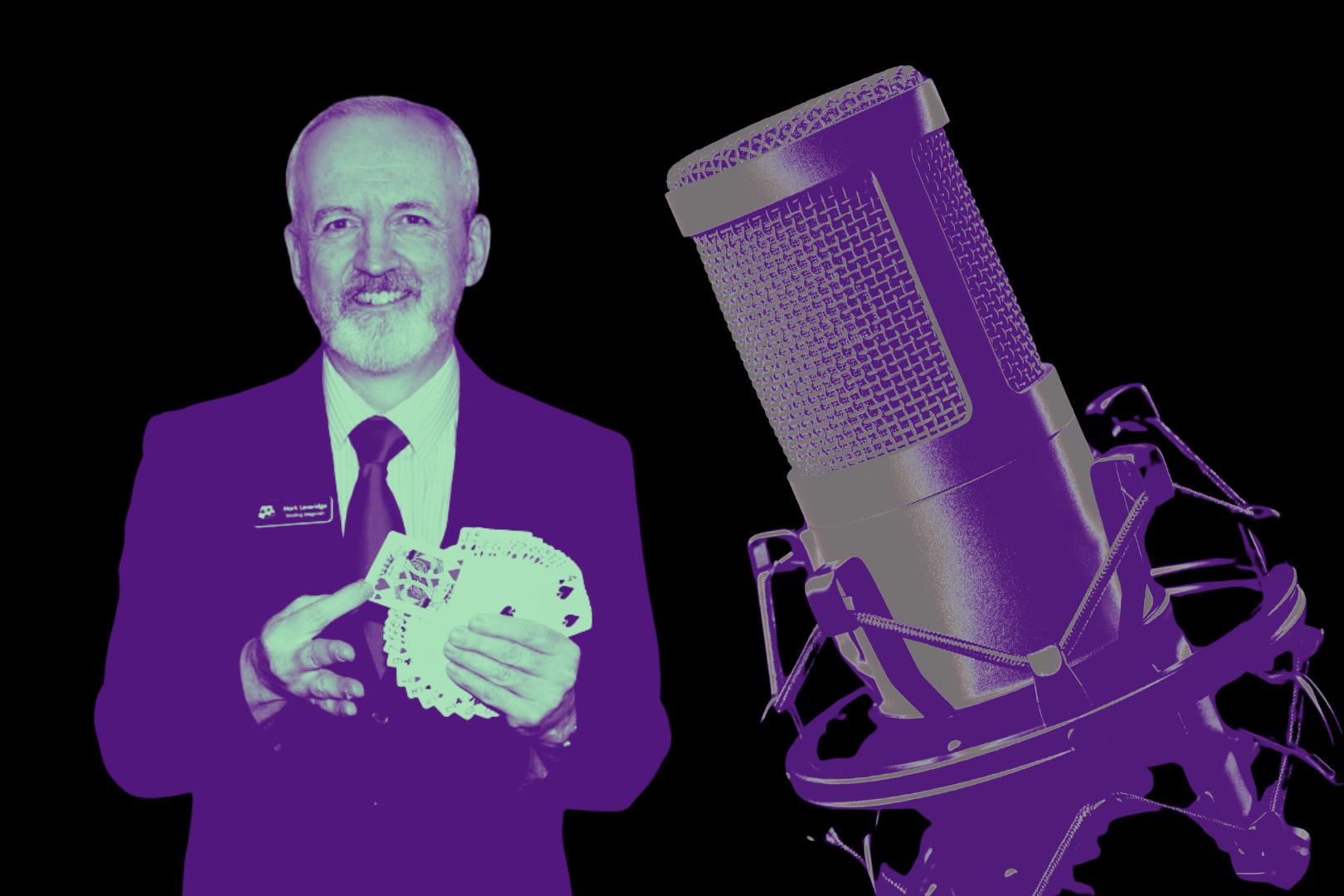
Mark Leveridge Magic Podcast 🎙
Recently, I’ve been seriously considering becoming a part-time professional, so I’ve been listening to past episodes of the Mark Leveridge Magic Podcast to learn more about the practical and business side of performing magic for a living. While I have a day job I like, the UK university where I work is in the middle of cutting 20% of its staff. Consequently, there’s a small but significant chance I might not have a job by the end of the year—fun times indeed! 🤣😭 I’ve decided that, regardless of what happens, it might be better for my future career prospects to establish multiple income streams, and performing magic for payment is an obvious option.
Back to the podcast. Mark began his monthly magic musings in January 2013, with no idea how long the show would last. Although he’s since moved to publishing it every two months, it’s still going strong: there are currently 115 episodes available on Podbean, although the first 23 episodes, from January 2013 to November 2014, appear to be missing from the archive. I like the show because, as a professional magician with over forty years’ experience, he shares practical tips and advice on the realities of making a living from performing magic—something very few magic podcasts do.
If you’d like to explore the podcast but aren’t sure where to begin, I’d recommend the August 2020 episode, in which Mark recounts a funny story about a close-up gig and a vicious seagull! This story perfectly encapsulates how he uses humorous, self-deprecating personal disasters to teach life lessons about the unpredictability of working as a professional magician.
As there are so many episodes, each 30 to 45 minutes long, I downloaded them all and added them to an AI-powered notebook using a Google service called NotebookLM. By doing this, I have access to an accurate transcription of each episode and can use Google’s Gemini chatbot interface to interrogate the text. For example, I asked it to provide me with Mark’s top five tips for amateur magicians who want to go pro. Here’s the response I got:
Here are Mark Leveridge’s top five tips for amateur magicians looking to make the leap to a professional career:
1. Calculate your financial needs and have a buffer
Before giving up your regular salary, you must recognise that professional magic income is often sporadic while living expenses are systematic. Mark advises calculating your total living expenses and dividing that number by your average show fee to find out exactly how many extra bookings you need to survive. You should also ensure you have some savings to fall back on during your initial transition.
2. Diversify your income streams
Mark warns against putting all of your eggs in one basket by relying on a single type of performance. To sustain a long-term career, you should branch out and offer multiple services, such as children’s parties, close-up magic, stand-up shows, trade show entertainment, lecturing, and even selling magic products.
3. Eliminate your fallback plan to enforce perseverance
Success requires a “never say die” attitude to survive the inevitable dips in bookings and income. Mark strongly advises against keeping a “parachute” or fallback option, such as planning to simply return to your old day job if magic does not work out. He argues that lacking an easy alternative provides the intense motivation required to make your magic career succeed.
4. Treat it like a genuine business
Show business is made up of two words: the show and the business. If you only focus on your act and ignore essential business skills like accounting, strategy, and self-promotion, you will not succeed. Mark recommends treating lead generation and marketing as your daytime job, utilising both online and offline advertising, and actively networking with local business groups.
5. Conduct a “risk assessment” on your act
The difference between an amateur and a professional is that an amateur expects everything to go perfectly, while a pro fully expects things to go wrong. You should perform a critical risk assessment of your act to anticipate potential technical or prop failures. By establishing contingency plans for major disasters—such as a broken invisible thread or failing electronics—you can recover seamlessly during a live performance.
This isn’t word-for-word what Mark said. The AI is consolidating and paraphrasing from the sources uploaded to the notebook. But, because NotebookLM is a “source-grounded AI”, it doesn’t introduce unverified information into its responses; it only uses the sources you’ve uploaded to the notebook—in this case, all 115 episodes of Mark’s podcast.
This technique, sometimes called Retrieval-Augmented Generation (RAG), can be used with any of the current crop of AI chatbots. The catch is that with most chatbots, RAG only adds information and, crucially, doesn’t prevent the model from using its broader training data (which might not always improve output quality). Source-grounding, however, is built into the very fabric of NotebookLM’s operation, making it much less likely to hallucinate (make stuff up). It also generates inline citations (footnotes) that link directly to the specific sections of your uploaded material. These citations allow you to verify the accuracy of AI-generated content and trace any information back to the original source it was extracted from (in this case, specific locations in the podcast transcripts). All of this makes it a much more reliable research tool than your average general-purpose chatbot.
I asked Gemini—the AI that powers NotebookLM—to compile a list of the podcast episodes it drew on to generate the top five tips. I did this on the assumption that some of you might also benefit from listening to the original source material. If you have a similar interest in “going pro”, the twelve podcast episodes below provide an excellent primer:
May 2015 - This episode provides foundational financial advice, including calculating your required show volume relative to your living expenses, ensuring you have a financial buffer, diversifying your income streams, and compartmentalising your marketing websites for different audiences.
March 2015 and November 2017 - These episodes emphasise the importance of keeping props immaculate, such as replacing dog-eared cards, swapping out dirty grey ropes for fresh white ones, and regularly polishing brass items.
May 2017 - This is where the strategy of proactively collecting testimonials and including relevant quotes in every email you send to a potential booker originates.
July 2017 - This episode contains advice to filter your inquiries by requiring bookers to complete a detailed form, thereby deterring casual “cold” leads.
April 2018 - Mark details the importance of compartmentalising your marketing to appear as an expert and explains that 90% of a professional’s energy should go into audience management, leaving only 10% for the trick mechanics.
May 2020 - This episode discusses cultivating a relentless “never say die” attitude by eliminating fallback plans, such as returning to an old day job, and introduces the concept of doing a “risk assessment” for your act.
April 2022 - Expanding on the risk assessment concept, this episode highlights the difference between amateurs who expect perfection and professionals who actively expect and plan for things to go wrong.
October/November 2022 - This episode addresses the unique challenges for semi-pros, emphasising the need to consistently project high energy and professional standards, even after a tiring day at a regular job.
April/May 2024 - Mark advises protecting your hard-won reputation by having the confidence to walk away from gigs where a booker has completely unrealistic expectations.
August/September 2024 - This episode provides actionable tips for mastering the live environment, specifically identifying amateur physical habits to eliminate, such as fidgeting, swaying, avoiding eye contact, and failing to project your voice.
December 2024/January 2025 - This episode is the source for the advice to step outside of magic circles and join local business networking groups to connect with business owners face-to-face.
If you’re sceptical of, or even a little intimidated by, AI, I’d encourage you to try NotebookLM to support your magical studies. You don’t have to stick to a single repository of information, as I did here. You can mix and match your favourite magical sources—podcasts, blog posts, magic books and periodicals—and start asking interesting questions.
I want to express my heartfelt thanks to Mark Leveridge for recording and sharing these podcast episodes for free. They’re an invaluable resource for anyone seeking to build a successful career in magic.
Imitation Aces
This month, I wrote up a fast-paced four-Ace trick called “Imitation Aces”. You can learn more about it in the latest edition of Packet Trick Paradise:
🃏🌴 Read Packet Trick Paradise #14: Imitation Aces 👈
This is the opening effect of a three-trick set called “Duty Aces”, which I’ll share in the next instalment of Corrupting the Classics (which is taking me a little longer than anticipated to write, but should be published sometime in May).
Royal Variety 👑
Paid subscribers can now learn one of the best packet tricks I’ve ever invented: “Royal Variety” in Packet Trick Paradise #13. The routine features four classic card-magic plots—Wild Card, Ambitious Card, Card Warp, and Cards to Pocket—all wrapped up in a playful circus-themed presentation. 🎪
Here’s what happens:
You announce that you’ll recreate the circus with just three cards.
“First into the big top are the clowns,” you say, displaying three identical Jokers. “But I prefer the quick-change artists.” The Jokers transform, one by one, into the Queen, King and Jack of Hearts.
“Then come the acrobats.” You perform a short, Ambitious Card sequence: the King repeatedly leaps to the top of the packet on your cry of “Allez Hop!”—finishing with two backflips (turning face down, then face up again, while trapped between the other two cards a la Card Warp).
“But my favourites are the magicians and their glamorous assistants.” The Jack is placed in your pocket and instantly jumps back to your hand. The Queen makes the same impossible journey. Finally, the King vanishes from between the Jack and Queen, reappearing in your pocket. All three cards are handed out for examination.
Square Holes
I recently came across an old Numberphile YouTube video about the “Square Hole” illusion—a geometric puzzle in which a large circular drinks coaster passes through a much smaller, rigid square hole in a sheet of paper. It works because folding the paper creates “elbow room” (ambient three-dimensional space) that isn’t present when it is flat, allowing the disc to pass through.
I think it’s this particular video, featuring Tadashi Tokieda, that inspired the recent wave of viral videos showcasing the puzzle on YouTube, Instagram and TikTok. A good example is Pete Firman’s Square Hole video on TikTok. (I’ve featured puzzle-based magic like this before in the Ruseletter—see Monthly Updates #8 and #9 if this stuff tickles your fancy.)
Three years ago, Canadian magician and master mischief-maker Ryan Pilling released a more magical version of the puzzle. For the ridiculously low price of $7 (about £5 or €6), you can learn several variations that add “one-degree” improvements to the optical illusion. He also provides a few alternative presentations and teaches you how to make the props (using custom-designed PDF files included with the package). My favourite approach is his “Houdini Through A Brick Wall”, which is the perfect paper-based trick to keep in your wallet.
You can find Ryan’s “Square Hole” at your favourite magic dealer. However, I’d recommend buying it directly from Ryan himself—creators tend to earn more per download this way.
Disclaimer: I’m not being paid to promote this product. I bought it myself and thought it was woefully underappreciated at the time of release and didn’t receive the attention it deserved. If you like what Ryan does in the video above, you won’t be disappointed.
Three Videos Worth Watching 📺
Here are three videos I’ve watched this month that I think you should watch too.
The Zabrecky Hour 💀
Duration: 15 minutes
A weird and wonderful performance by Rob Zabrecky, in which he hosts an unconventional birthday séance and invites audience members to participate in a series of mysterious spectral experiments. Attendees handle odd artefacts and take on strange challenges to determine whether communication with the afterlife is truly possible.
Strong Magic Show by Michael Vincent
Duration: 21 minutes
Here’s another full act from the incomparable Michael Vincent. The show features a variety of classic routines, including the Hold-Up Trick and the Linking Rings. Between effects, Michael shares personal stories about his magic mentors, the philosophy behind magic, and the importance of elements such as drama, suspense, and perception in creating a successful trick. The performance combines technical skill with masterful storytelling, culminating in a philosophical reflection on balance and beauty inspired by Lao Tzu.
Oz Pearlman on the WHCD Attack
Duration: 13 minutes
I was startled to hear that Oz Pearlman, mentalist and former demo guy for Penguin Magic, was performing right next to President Trump during the recent White House Correspondents' Dinner shooting. What was even more shocking, at least to me, was how many people seemed indifferent to the event, as if an assassination attempt on the President of the United States were the most ordinary thing in the world. We live in very strange times!
In the video, Oz recounts his harrowing experience. He describes the sudden shift from performing a mind-reading routine for the President, First Lady and Press Secretary Karoline Leavitt to diving for cover as Secret Service agents took the President to the floor on stage. He describes the surreal moment of locking eyes with Trump from a few feet away amid the chaos, and his initial fear that a bomb was about to go off.
I hope you enjoyed this monthly update. If you’d like more tips on using AI as a study aid, please let me know in the comments or by replying via email.
Yours Magically,
Marty
P.S. I thought I’d start adding bonus content at the very bottom of the newsletter to reward my most dedicated readers.
The Brutal Business of Professional Magic
You may be aware that NotebookLM can generate new forms of media from the sources in your notebook. One of these is an “audio overview” featuring two over-enthusiastic American podcasters discussing the source material. Here’s an example on the topic of becoming a professional magician. I’m not sure whether it encourages me to become one or puts me off entirely! But it does synthesise much of Mark’s excellent advice on the topic into a handy long-form podcast episode.
Finally, here’s the prompt that I used within NotebookLM to create the audio overview above. You might like to try using it with other AI-powered tools, such as ChatGPT, Gemini, Claude, Perplexity, or Lumo (a more privacy-focused option).
You are a professional magician and performance career coach with deep experience guiding amateur performers through the transition to full-time professional magic. I’m an amateur magician, seriously considering going pro, and I want a comprehensive, honest assessment of everything I need to think through before making that leap.
Analyse the full picture of this transition—covering the artistic, business, financial, psychological, and practical dimensions. For each area, go beyond surface-level advice: identify the non-obvious pitfalls, the things most amateurs underestimate, and the decisions that tend to make or break early professional careers. Where relevant, distinguish between different professional paths (close-up/table magic, stage shows, corporate entertainment, children’s parties, trade shows, etc.) since the considerations differ meaningfully.
Draw on real patterns you’ve observed in performers who succeeded versus those who struggled. Be direct about the hard truths—the income reality, the rejection, the identity shift from hobbyist to professional—not just the inspiring upside. Prioritise depth over breadth: if certain considerations are genuinely more critical than others, make that hierarchy clear.