
Welcome to the June 2026 monthly update for Marty’s Magic Ruseletter. Thank you to everyone who sent me well-wishes in response to my current difficulties at work. I still have a job, but my post remains at risk. There won’t be a resolution until mid-August, so I’ll just have to wait and see what happens.
In the meantime, I’ve been exploring classic “folk card magic” from the pages of Scarne on Card Tricks and Mathematics, Magic and Mystery. I also discovered a couple of new words this month that I think are perfect for magicians, mentalists and mystery performers. Finally, I’ve been contemplating what kind of Batman I want to be when I perform my magic! But first, some new content on my blog, Marty’s Bag of Tricks…
New on MBOT: Duty Aces, Number of the Brain-Rotten Beast & Don’t Call It Art Review
I’m trying to publish more content on my blog because it’s my happy place. This month, I published three new articles.
Learn Duty Aces
You can now learn my three-card set, “Duty Aces”. It uses nothing more than the three Aces and a black envelope. The presentation is based on the eventful history of the Ace of Spades and its surprising link to the British tax system.
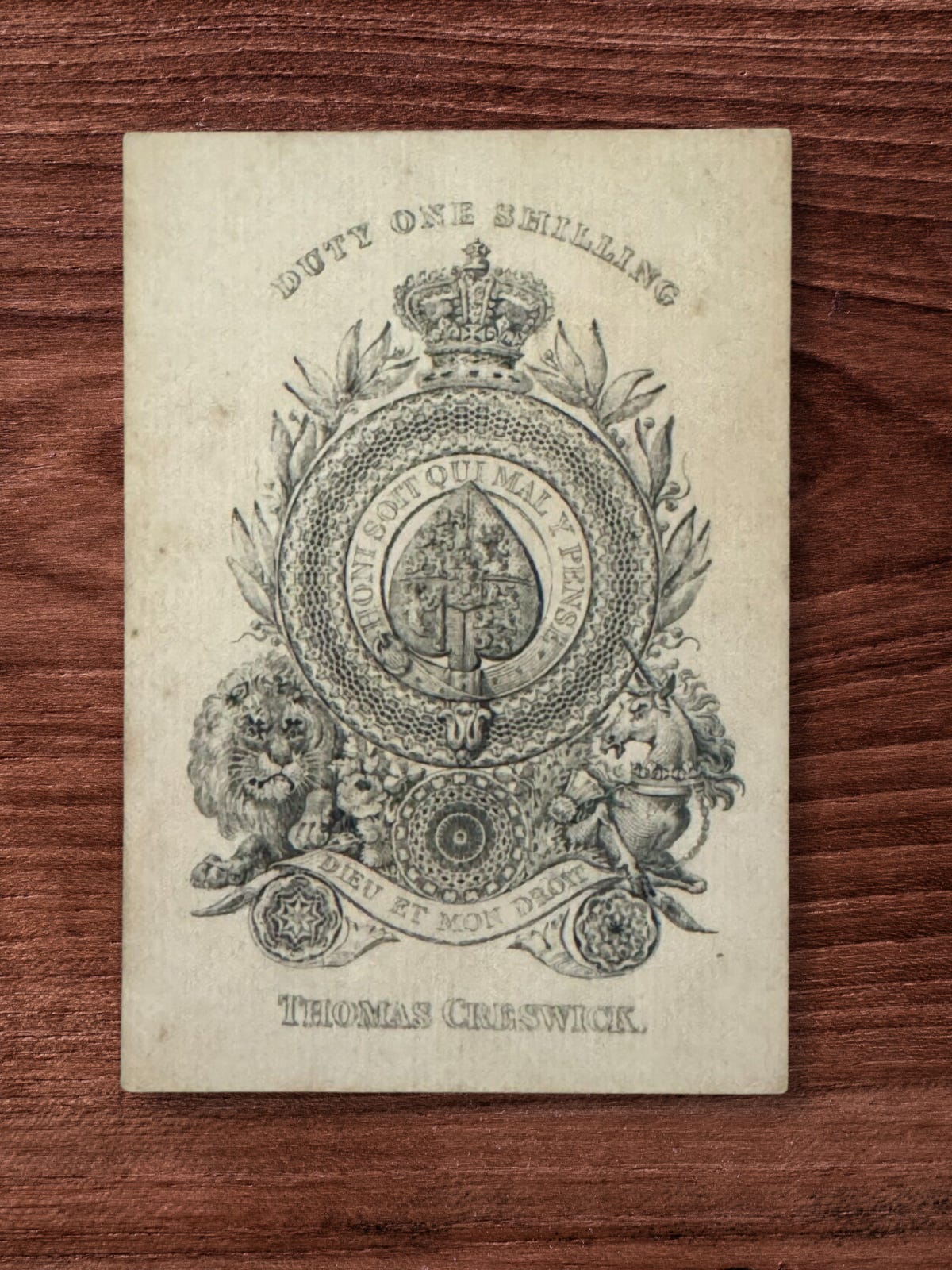
The first trick of the set, “Imitation Aces”, is a small packet version of Wild Card. It’s a visual four-card opener in which three apparent “forgeries” of the Ace of Spades sequentially transform into the other three Aces (Diamonds, Hearts, and Clubs).
The second effect is a relaxed, table-based handling of Dai Vernon’s classic packet trick, “Twisting the Aces”. The four Aces mysteriously turn face up, one at a time. For the grand finale, the notoriously stubborn Ace of Spades turns over while completely isolated inside an examined envelope. The presentation is based on “Old Frizzle”, a highly detailed, banknote-style playing card introduced by the UK government in 1828 to counter forgery, featuring intricate foliage, a lion, and a unicorn (see the image above).
The third and final effect is a humorous take on “The Last Trick of Dr. Jacob Daley”, featuring a Victorian cartomancy presentation. The four Aces are introduced through their period meanings—love and money for the red pair, and death and taxes for the black pair. The red and black Aces then invisibly transpose. A participant chooses between love and money, draws death, and finds taxes waiting on the table, while the two red Aces (love and money) turn up safely inside the envelope. This is the closing trick in the “Duty Aces” card set.
The blog article also offers a detailed look at the history of the Ace of Spades. Even if you don’t want to perform “Duty Aces”, you may well find some of these historical details useful in a presentation for another card trick involving the four Aces. There certainly are enough of them!
This is one of my favourite four-Ace routines because it also conveys my passion for the history of playing cards to my audience. I hope you enjoy practising and performing it.
Learn the Number of the Brain-Rotten Beast
Here’s a short blog post about another new trick of mine. This one is available only to paid subscribers. However, if you’re familiar with Karl Fulves’s “Gemini Twins” concept, you’ll be able to devise your own handling for the trick using my suggested presentation.
If you’ve been reading the Ruseletter for a while, you’ll know I’m fond of card tricks with a Faustian feel.
If you want to learn some more tricks with a similar satanic theme, I’d recommend you read Tricks, Tricks & More Tricks #3: Satanic Sorcery. 👿
Don’t Call It Art Book Review
Finally, I wrote a long book review for Don’t Call It Art by Austin Kleon. While this isn’t a magic book, I think many magicians would benefit from reading it (TL;DR: If you’re serious about magic as an art form, I think this is required reading). I’ve tried to make it an entertaining read and relate the concepts discussed in the book to the world of magic and magicians. I hope you enjoy it.
Here’s one of my favourite pages from the book:
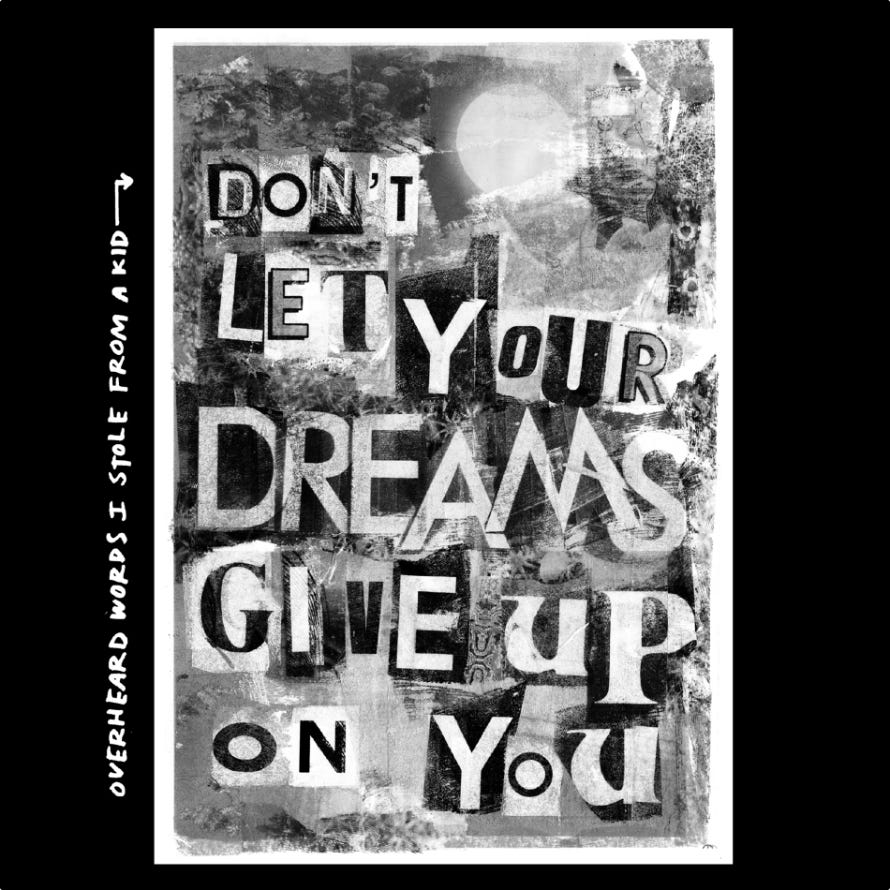
This motivational collage expresses a sentiment very similar to a quote I read in a recent newsletter from James Clear (the bestselling author of Atomic Habits):
“Chase your dreams. It’s unlikely they will play out exactly as you expect, but they know the way. No vision is perfect, but it points in the right direction. Let the energy of your soul lead you.”
Kleon’s book is chock-full of similar quotes and inspirational ideas, making it a perfect gift for anyone with an artistic soul who is struggling to make art.
Folk Card Magic
As I mentioned in last month’s update, I’m working on a card magic course based on several pieces of “folk card magic”, such as the infamous Twenty-One Card Trick.
This month, I was inspired to revisit a classic self-working card trick after seeing a couple of viral videos on Facebook: one by mumfluencer Elizabeth Etecetera and another by magician Ash Marlow. Elizabeth’s video has garnered 2.1 million views, while Ash’s demonstration has an amazing 3.4 million! This is clearly how folk card magic is shared these days—not by good old Uncle Bob but by content creators on social media. I’m not sure if this is a good or bad thing, but it is the reality we have to deal with.
Anyway, Ash confidently asserts in his video, in big, bold text, that “NOBODY CAN EXPLAIN THIS?” (I’m not sure why he thinks that’s a question), possibly oblivious to the fact that Martin Gardner (1914 - 2010) already did so in 1956 in his book Mathematics, Magic and Mystery. Both of these viral videos feature tricks based on what Gardner calls the Compensation Principle. The trick performed by Elizabeth originates with Henry Christ (1903–1972), the influential New York magician, and is also explained in Mathematics, Magic and Mystery (see page 9). The trick Ash is performing is a three-pile variation of “A Baffling Prediction” from the same book (see page 7).
Both tricks can be traced to trick Number 30 in Scarne on Card Tricks (1950), “Mathematical Finder” (see page 55). A trick that uses the same mathematical principle, called “Prophetic Card Discovery”, appears in The Tarbell Course in Magic, Volume II (Revised Edition), published in 1942. The trick is uncredited, although the write-up mentions it is a favourite of E. J. Moore.
I published a trick called “Pythagorean Prediction” three years ago in Tricks, Tricks & More Tricks #2, which also uses the same mathematical principle.
The Pythagorean presentation attempts to justify the use of the number ten. It’s a clever trick, but it requires a special thirty-three-card Piquet pack. I encourage you to give it a go.
The handlings circulating on Facebook, much like the most popular pieces of folk magic, make the tricks easy to remember and teach to others. If you can remember the correct sequence of events, the magic just works. Still, these effects deserve better presentations that more effectively disguise the mathematical method. I’ll be sharing several ways to do this in a future edition of Corrupting the Classics.
Words for Magicians
This month, I came across two new words I’d never heard before. The first, wonderclout [WUHN-der-klout], is a sixteenth-century English noun used to describe something or someone that is showy on the outside but worthless, useless, or disappointing on the inside. The term blends “wonder” (a marvellous thing) and “clout” (an old word for a useless rag or cloth). It immediately struck me that although I love magic tricks, many are performed in a way that turns them into wonderclout.
The other is fingerspitzengefühl [FING-er-shpit-tsun-guh-FYOOL], a German loanword—a term adopted from one language and incorporated into another—that literally translates as “fingertip feeling”. Figuratively, it denotes an intuitive flair, instinct, or delicate tact. It can also describe the ability to handle tricky situations with perfect sensitivity, knowing exactly what to say or do without causing offence. The best magicians, especially those well-versed in sleight of hand, surely have fingerspitzengefühl in abundance!
What Type of Batman Do You Want to Be? 🦇
For as long as I can remember, I’ve been a fan of comic-book superheroes. As a kid, I loved Superman (thanks to the Christopher Reeve films) and the Incredible Hulk (thanks to the late-seventies and early-eighties TV series). However, as I got older, I began reading darker depictions of life as the Caped Crusader, and, as a result, Batman became my favourite superhero. My love for Batman continued to grow after watching Tim Burton’s 1989 film. I then became an avid viewer of Batman: The Animated Series (BTAS). I still consider it one of the greatest comic-book adaptations of all time, and Kevin Conroy’s portrayal is, in my book at least, the definitive depiction of Gotham City’s Dark Knight.
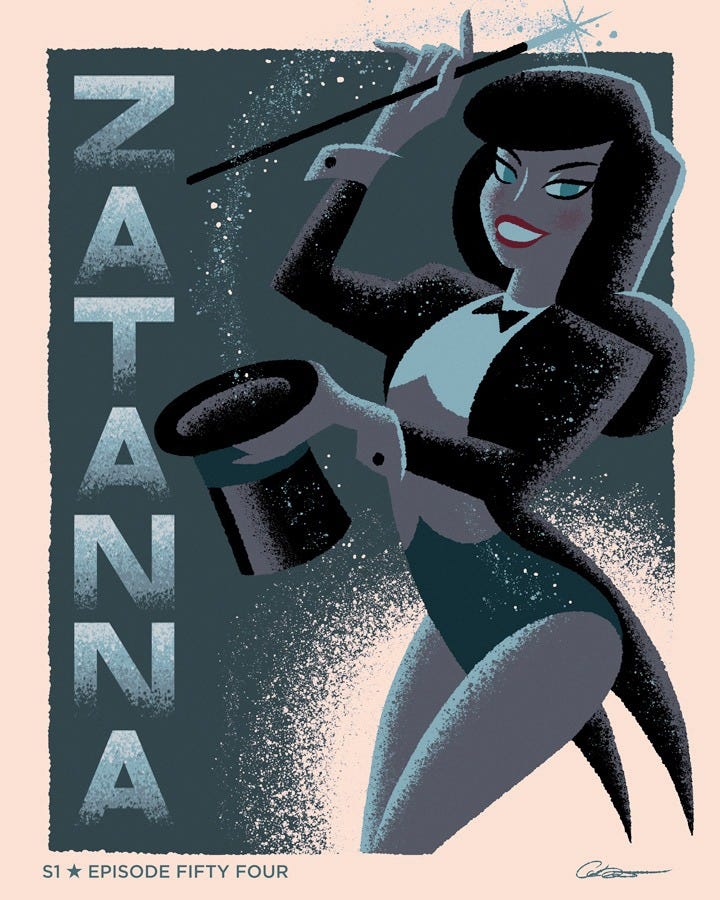
The Batman portrayed in BTAS has a mysterious persona, reminiscent of a film noir private detective. A few episodes even featured theatrical magic, most prominently in “Zatanna”, the fifty-fourth episode of the first series (a favourite of mine). As a result of my love for BTAS, I think I modelled part of my early magical performance persona on that version of Batman (mysterious and a little aloof).
More recently, through my exploration of more playful presentations, I’ve decided that my performance persona is now more akin to the wacky Batman from the 1960s TV series, as portrayed by the legendary Adam West. The show worked so well because it didn’t take itself too seriously. This, I think, is one reason I don’t care much for Christopher Nolan’s Batman trilogy, even though I appreciate its gritty, rust-belt aesthetic. For me, his forced realism sucked all the fun out of Batman; plus, I can’t take Christian Bale seriously as the Dark Knight when he speaks the way he does in the films. His vocal delivery would be better suited to the stage in a British Christmas panto!
So, which Batman are you most like when you perform magic? Are you serious and solemn (1989 Batman), mysterious and hard-boiled (BTAS Batman), gritty and intense (Nolan Batman) or maybe even overconfident and a little unhinged (Lego Batman)?
Three Videos Worth Watching
Here are three videos that I watched this month that I think you should watch, too.
Impossible Close Up Street Magic in NYC
Duration: 24 minutes
Here’s some great David Blaine-style street magic by Jonathan Schumacher (JS Magic).
Watch out for a fun version of Dr. Daley’s Last Trick towards the end of the video. It shows how powerful this effect can be. I also like how Jonathan involves two spectators in the trick. The whole video highlights the truism that sometimes the simplest tricks, without multiple phases or complicated kickers, are often the most effective.
The Mysterious Origins of Abracadabra and Other Magic Words
Duration: 8 minutes
A very informative and entertaining video exploring the origins of several well-known magic words.
The Storied channel on PBS has lots of excellent arts and humanities content worth a closer look.
Batmania Born
Duration: 30 minutes
If you’re unfamiliar with this iconic show, I recommend watching the following documentary about the 1960s Batman TV show.
Well, that’s it for another month. Tune in next month for another update. Same Bat-time, same Bat-channel!
Yours Magically,
Marty
P.S. My friend David Ung has started writing again on his wonderful Substack, The Art & Appreciation of Magic. His latest article on counterfeit magic tricks is well worth reading.

Thanks for the shout out!
I love all versions of Batman but haven't thought about what type I'd be, I think it'd be more leaning towards a TAS Bruce Wayne is what I want to be!