
Welcome to the much-delayed fourth instalment of Tricks, Tricks & More Tricks, a regular Ruseletter column featuring routines linked by plot, method, or presentation. The reason you’ve been waiting so long for this article to be published is that I ended up writing up a total of thirteen new tricks for it—crazy, I know! But I’m now relieved to have these routines out of my head and recorded here for posterity and for others to learn, practise, perform, and, hopefully, enjoy! (As this is a very long article, you might be best to read it on the Ruseletter website.)

In this edition, we are trading the fire and brimstone of my previous article, Tricks, Tricks & More Tricks #3: Satanic Sorcery, for hearts, flowers, and the mysterious forces of fate and destiny. In short, we are moving from the Devil to dating! 👿🥰
It is a drastic thematic shift. Yet, the underlying methods used here rely on similar techniques. Whether you are damning a spectator’s soul or locating their true love, you’ll be relying on the Count-Back Force (10-20 Force), the Principle of Nine, the Swindle Shuffle and the Down-Under and Under-Down Deals. So nothing particularly challenging on the technical front, which will enable you to focus on making a deep connection with your audience.
Like previous material I’ve shared via the Ruseletter, such as Red Thread of Fate, these tricks are ideally suited for performance at a wedding, especially for the bride and groom. Therefore, I’ve written most of them assuming you’re in this situation, either as a paid professional or a wedding guest who is “gifting” a magical experience to the happy couple. Of course, the routines can be adapted for any couple in nearly any situation, with some modifications to the included presentations.
So, let’s move on from demonic pacts and explore magic suitable for a newlywed couple, though I’ll let you decide which is the riskier commitment!
Merry Christmas! 🎅🎄🎁
As this is the final Ruseletter before the holidays, I want to wish you a festive season filled with too many mince pies and lots of magic. Have a very Merry Christmas and a Happy New Year! 🎄🥳
If you are looking to treat yourself (or perhaps avoid talking to your in-laws by practising magic in the other room), the 25% discount on annual subscriptions is still available until the end of December.
This is the cheapest I’ll ever offer an annual subscription to the Ruseletter, and I’m not entirely sure when, or even if, I’ll repeat this promotion. Right, that’s enough shameless promotion for one newsletter!
The Principle of Nine
Much of the magic featured in this article relies on the Principle of Nine. I first encountered this mathematical curiosity back when I was at university (studying computer animation and special effects). One of my lecturers sent around a magic trick using a relatively new web software called Flash, which is now a dead technology.🪦 It was appropriately called The Flash Mind Reader and was created by a web designer called Andy Naughton (now Andy Wolfe). Thanks to the Internet Archive, you can still run the trick using an emulator.
This is what Andy has to say about it:
Soon after uploading it to my (then small) server it ‘went-viral’ (probably before the phrase viral was coined) and crashed my site within days. At one point I was getting up to 500 emails a day asking how the Mind Reader worked or suggesting that I was spying on people through their computers. Aaah the early days of the internet…
Over the years I have created many versions of the Mind Reader for clients, usually professional magicians or psychics.1
Anyway, this rudimentary computer-based trick perfectly illustrates the mathematical concept at the heart of the Principle of Nine and how deceptive it can be: if you take any integer, sum its digits, and subtract that sum from the original number, the result will always be a multiple of nine.
This is what makes the Count-Back Force work. Here’s the proof:
10 - (1 + 0) = 9
11 - (1 + 1) = 9
12 - (1 + 2) = 9
13 - (1 + 3) = 9
14 - (1 + 4) = 9
15 - (1 + 5) = 9
16 - (1 + 6) = 9
17 - (1 + 7) = 9
18 - (1 + 8) = 9
19 - (1 + 9) = 9
Therefore, if you place a known card in the tenth position from the top of the deck, you can force it on a spectator by asking them to choose any number between ten and twenty. Have them deal that many cards from the deck. Instruct them to add the two digits of the number together, then count that many cards back onto the deck. This puts the force card on top of the deck.
Alternatively, you can position the force card ninth from the top. This will cause the card to end up on top of the packet your participant is holding. I tend to prefer this method because you can ask them to peek at the top card, remember it, and then shuffle the packet. These cards can then be cut into the deck, and the cards can be thoroughly shuffled. This procedure makes the selection process seem much fairer than it actually is. (Even so, the initial selection of the card does still feel a little mathematical.)
As well as forcing a known card, you can also use it to force a known number of cards, e.g., 9, 18, 27, 36, 45, 54. In this way, you can also force a full nine-card setup (or any multiple of nine, for that matter). These ideas are explored in some of the tricks below, but I also encourage you to experiment with these ideas yourself.
Four Simple Routines
Let’s begin our exploration with four simple routines. The first employs the placement procedure from Karl Fulves’ self-working classic, “Gemini Twins”. There’s also a variation of another Karl Fulves trick, “Double Disclosure”, from his book Self-Working Card Tricks (1976, Dover Publications, Inc.). I’ve also included two basic applications of the Count-Back Force, one inspired by Johann Nepomuk Hofsinzer and the other by Ed Sheeran!
Simplex Soulmates 💕
🔒Paid-Subscriber Exclusive
Difficulty: ⭐⭐ (Easy)
Duration: ⏱️⏱️ (3-5 minutes)
Setup Time: 🎯 (Minimal)
📋 Quick Reference:
Effect Type: Full Deck Coincidence Effect
Audience Size: Close-up/Parlour
Reset Time: Instant
Key Moves & Principles: Double Lift, E-Y-E Count
This is my “soulmate” handling of “Gemini Twins” by Karl Fulves (originally published as “Stopped Twice” in Impromptu Opener, circa 1979).
I shared this with paid subscribers back in September, in Easy Does It #7. The reason I’m including a link to it here is that this was my starting point for all of the tricks included in this edition of Tricks, Tricks & More Tricks. “Simplex Soulmates” was inspired by a similar card trick called “Soul Mates” in Magic for Dummies by David Pogue (1998, Wiley Publishing, Inc.). See Chapter 10, page 200, for complete details.
The author mentions that the trick is a speciality of Jon Racherbaumer (1940-2024), so I can only assume that he suggested the theme of the trick and its inclusion in the book. Oddly, the fact that the trick is based on Fulves’ “Gemini Twins” isn’t mentioned at all. Unfortunately, magic books aimed at the general public are often light on crediting (something you cannot say about Marty’s Magic Ruseletter, I hope).
If you’re unfamiliar with “Gemini Twins,” Tom Salinsky offers an interesting variation that uses named cards in his notes, Clean, Simple, Direct (available for free from his website). Instead of removing “predictions” that are the mates of the top and bottom cards, he employs a cut and a cull to select two named cards while preparing the deck for the subsequent coincidence effect. While this moves Fulves’ original away from its self-working roots, I think it is a very intelligent approach to this plot and worth exploring.
Murphy’s Magic Supplies has recently released a trick based on “Gemini Twins” called “Ghost Deck” (it is actually a minor variation of “Rainbow Miracle” by Nick Trost, circa 1984). This deck would help enhance the “soulmates” presentation:
And finally, here’s another helpful variation on Karl Fulves’ classic called Gemini Twins Reloaded that you might also like to play around with.
Surefire Soulmates 👩❤👨
Difficulty: ⭐ (Easy)
Duration: ⏱️⏱️ (3-5 minutes)
Setup Time: 🎯🎯 (Moderate)
📋 Quick Reference:
Effect Type: Full Deck Coincidence Effect
Audience Size: Close-up/Parlour
Reset Time: Moderate
Key Moves & Principles: Pre-Arrangement, Count-Back Force
This routine has an enchanting “Love Me, Love Me Not” presentation that resonates strongly with married couples.
Johann Nepomuk Hofsinzer inspired this routine’s presentation. It uses a thirty-two-card Piquet pack combined with the Count-Back Force. Whether they name a high or low number, deal face up or face down, they will always find their perfect match.
The maths handles the heavy lifting, allowing you to concentrate fully on connecting with your audience. The reduced thirty-two-card deck also feels different to a regular deck—it’s notably thinner, easier to shuffle, and authentic to the golden age of magic, when Hofzinser was impressing audiences in his salon in Vienna with his romantic routines. Best of all, it gives you an excuse to continue your card magic set using the Piquet pack, which makes a lot of sleight of hand far easier to execute!
Soulmate Synchronicity 💞
Difficulty: ⭐⭐⭐ (Intermediate)
Duration: ⏱️⏱️ (3-5 minutes)
Setup Time: 🎯 (Minimal)
📋 Quick Reference:
Effect Type: Full Deck Coincidence Effect
Audience Size: Close-up/Parlour
Reset Time: Instant
Key Moves & Principles: False Shuffle, Slip Cut, Slip Shuffle, Double Turnover
This routine is my variation of “Double Disclosure” by Karl Fulves from his classic card magic book Self-Working Card Tricks (1976, Dover Publications, Inc.). I’ve added a couple of slip cuts, some false shuffles and a few double turnovers. While this takes it out of the strictly self-working category, it dramatically increases the effect’s deceptiveness.
The trick uses a straightforward setup that you can easily get into from a shuffled deck in use. However, it still delivers a single powerful punch of magic, resulting in the magical pairing of the King and Queen of Hearts.
The Joker and the Queen 🃏👑
Difficulty: ⭐ (Easy)
Duration: ⏱️⏱️ (3-5 minutes)
Setup Time: 🎯 (Minimal)
📋 Quick Reference:
Effect Type: Full Deck Coincidence Effect with Kicker
Audience Size: Close-up/Parlour
Reset Time: Minimal
Key Moves & Principles: Count-Back Force
What happens when a magic trick seems to go wrong? In this routine, you attempt to find a romantic match for the Queen of Hearts, only to end up with… a Joker. Just as the audience begins to chuckle at the mismatch, you reveal the stunning kicker: the Joker and the Queen are the only red-backed cards in a blue-backed deck.
While this routine is self-working and easy to perform, do not underestimate its impact—it is incredibly charming and entertaining. The method utilises an unusual face-up variation of the Count-Back Force combined with an Under-Down deal to force two odd-backed cards on a spectator.
Inspired by the Ed Sheeran and Taylor Swift ballad “The Joker and the Queen”, this trick transforms a simple card location into a romantic piece of theatre perfect for couples or weddings. The climax proves that opposites really do attract!
Hofzinser’s Royal Marriages 👑
In the gaslit salons of nineteenth-century Vienna, Johann Nepomuk Hofzinser proved that card tricks could be more than puzzles—they could be poetry. His classic plot, “Royal Marriages”—taken from the second half of his routine “The Queen of Hearts”—remains the gold standard for romantic card magic.
In his original trick, the four Kings each transform into the Queen of Hearts (symbolising their shared infatuation with her) before reverting to their proper form. Then, to determine their fate, audience members name four random numbers. The cards at those exact positions are dealt onto the Kings, and when revealed, each King is found paired with his perfect match—the Queen of the same suit.
By transforming the deck into a metaphor for desire and destiny, Hofzinser demonstrated that true love—at least in the hands of a skilled conjurer—is inevitable. As the master magician himself concluded:
“And in this manner we succeed in arranging instead of four unhappy courtships… four happy marriages!”
More than any other card plot, Royal Marriages, as popularised by Dai Vernon, is perhaps the most romantic trick to perform for a couple.
Below, I am sharing my favourite version of the modern eight-card Royal Marriages plot, titled “Australian Dating Service” (you’ll understand why I’ve called it this when you read the explanation). I have also included links to two additional versions of the trick previously published in the Ruseletter.
Australian Dating Service 🇦🇺
Difficulty: ⭐ (Easy)
Duration: ⏱️⏱️ (3-5 minutes)
Setup Time: 🎯 (Minimal)
📋 Quick Reference:
Effect Type: Packet Trick (Eight-Card Royal Marriages)
Audience Size: Close-up/Parlour
Reset Time: Instant
Key Moves & Principles: Down-Under Deal, In-the-Hands In-Faro, Double Lift
“Australian Dating Service” breathes new life into Hofzinser’s classic Royal Marriages by trading courtly romance for the chaotic world of modern dating apps. As you match up the Kings and Queens, you guide your audience through the familiar frustrations of swiping, liking and filtering, making the magic instantly relatable and conversational. It’s a great icebreaker for casual performances, transforming what could be a dull card puzzle into a charming piece of card conjuring that resonates with anyone who has ever searched for love online. ❤️
What sets this particular handling apart from existing ones is that it addresses a common flaw in the Royal Marriages plot: the anticlimactic ending. By adding a “Blind Date” phase with an apparent mismatch, you introduce genuine tension and surprise just when the audience is falling asleep. Best of all, the method is almost entirely self-working (it requires a single Double Lift), making it perfect for beginners. You can concentrate fully on your performance, confident that the “Aussie Algo” will take care of the rest!
Sixpence Ceremony 💒👰🏻🤵🏻🕊
Difficulty: ⭐⭐ (Intermediate)
Duration: ⏱️⏱️ (3-5 minutes)
Setup Time: 🎯 (Minimal)
📋 Quick Reference:
Effect Type: Packet Trick (Eight-Card Royal Marriages)
Audience Size: Close-up/Parlour
Reset Time: Minimal
Key Moves & Principles: Swindle Shuffle, Two-Card Coin Production
I published this romantic card trick earlier this year in April (see Easy Does It #4). “Sixpence Ceremony” is a romantic, self-working interpretation of the Royal Marriages plot, explicitly designed for couples and wedding performances.
By combining the audience-controlled “Ramasee Principle” with the folklore of lucky silver sixpences, this highly interactive routine proves that love always finds a way. As the trick isn’t technically demanding, it allows you to focus entirely on the presentation and the surprise coin-production finale.
Split Soul Theory
🔒Paid-Subscriber Exclusive
Difficulty: ⭐ (Easy)
Duration: ⏱️⏱️ (3-5 minutes)
Setup Time: 🎯 (Minimal)
📋 Quick Reference:
Effect Type: Packet Trick (Eight-Card Royal Marriages)
Audience Size: Close-up/Parlour
Reset Time: Minimal
Key Moves & Principles: Swindle Shuffle
“Split Soul Theory”, first published in Packet Trick Paradise #11, is an easy yet emotional packet trick tailored for couples, making it an ideal repertoire piece for romantic events, such as weddings, anniversaries, and even Valentine’s Day shows. By complementing the Royal Marriages plot with the ancient mythology of soulmates, this routine transforms a simple card trick into a resonant reunion ritual.
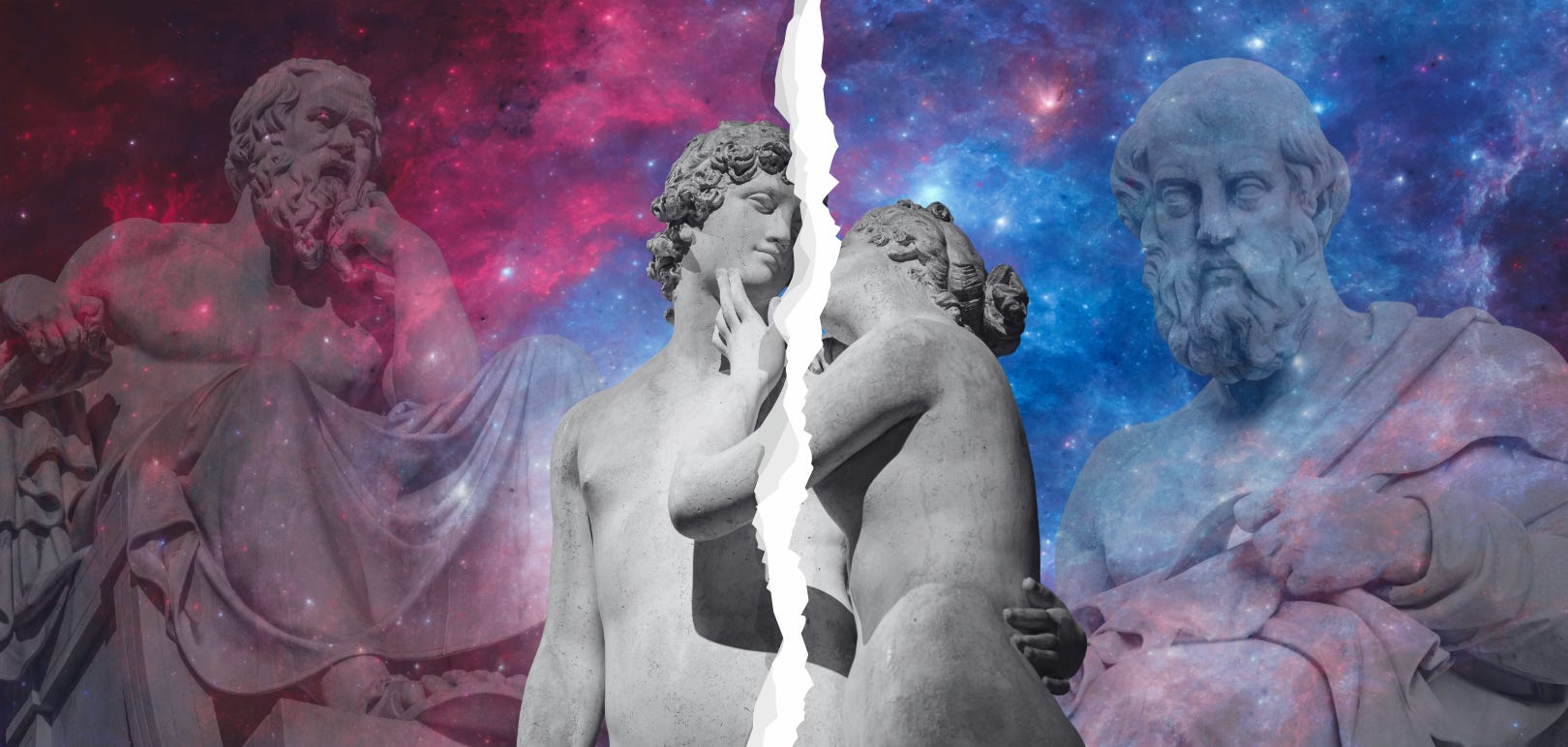
The routine is technically accessible—relying on self-working principles rather than difficult sleights—allowing you to focus entirely on connection, storytelling, and the profound moment when the spectators reveal that they have found their perfect match.
Routines Involving Envelopes
These two routines use envelopes as an integral part of the method and presentation. My starting point for these two tricks was “Wagers of Sin” by the late Max Maven, published in The New Invocation (issue 35, October 1986, pages 416-419).
Soulmail 💌
Difficulty: ⭐ (Easy)
Duration: ⏱️⏱️ (3-5 minutes)
Setup Time: 🎯🎯 (Moderate)
📋 Quick Reference:
Effect Type: Full Deck Coincidence Effect
Audience Size: Close-up/Parlour
Reset Time: Moderate
Key Moves & Principles: Si Stebbins Stack, Envelope Load
“Soulmail” is a charming two-phase routine designed specifically for couples, making it a potential feature piece for wedding performances. It combines a clever stack-based coincidence effect with a “Double Happiness” prediction, culminating in a meaningful moment where the couple’s teamwork creates the magic.
Because the routine ends with a physical gift—a red envelope (a Chinese “Hangbao”) containing the lucky “Double Happiness” cards—it leaves the couple with a permanent keepsake of their special day, elevating this from a simple card trick to a memorable magical experience.
Double Happiness
Difficulty: ⭐⭐ (Easy)
Duration: ⏱️⏱️ (3-5 minutes)
Setup Time: 🎯 (Minimal)
📋 Quick Reference:
Effect Type: Full Deck Coincidence Effect
Audience Size: Close-up/Parlour
Reset Time: Moderate
Key Moves & Principles: Count-Back Force, Principle of Nine, Envelope Load
I published “Double Happiness” back in October (see Easy Does It #8), but I’m including it here because it was explicitly designed as a piece of wedding magic. It is a poignant, self-working performance piece for the bride and groom on their special day. Using the mystical art of numerology, the happy couple take part in a “love ritual” using a deck of playing cards.
By combining the ancient Chinese symbolism of the “Hongbao” (red lucky envelope) and the Chinese concept of Double Happiness (囍) with a personalised numerological reading, this routine creates a deep emotional connection with the bride and groom.
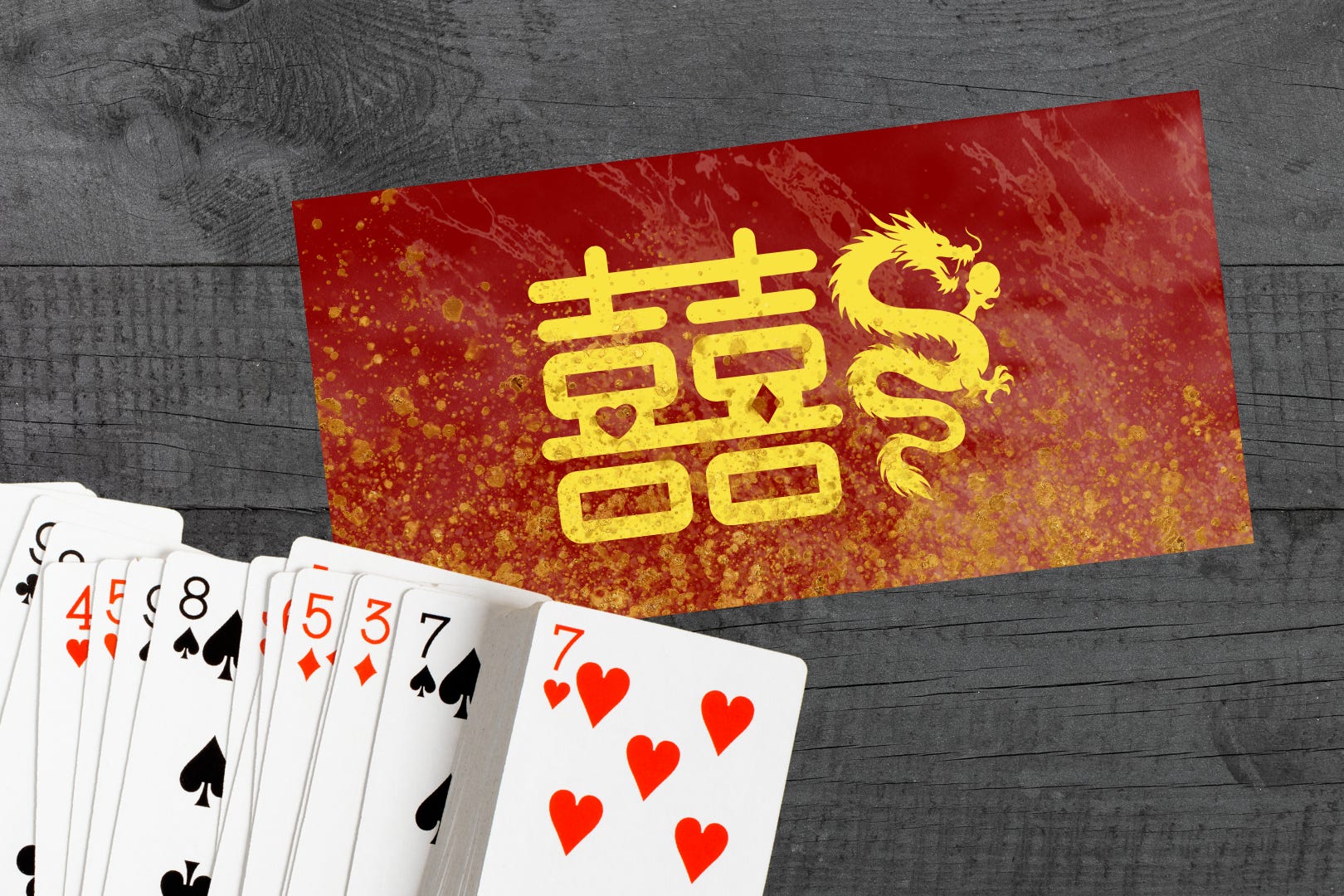
The couple make intuitive choices about their cosmic connection, only to discover that their destiny was written in the cards all along. The routine culminates in a stunning coincidence using the lucky red Eights, leaving the newlyweds with a powerful souvenir of the magic and a memory they will cherish forever.
Date of Destiny 📅💕
Difficulty: ⭐⭐ (Easy)
Duration: ⏱️⏱️ (3-5 minutes)
Setup Time: 🎯🎯 (Moderate)
📋 Quick Reference:
Effect Type: Full Deck Coincidence Effect
Audience Size: Close-up/Parlour
Reset Time: Moderate
Key Moves & Principles: Count-Back Force, Principle of Nine, Envelope Load
“Date of Destiny” is another romantic card trick and the perfect alternative to “Double Happiness” for unmarried couples. While wedding magic is popular in the UK, performing for dating couples or those “contemplating the plunge” is a massive, underserved market (it might also generate you some more business as a wedding magician!).
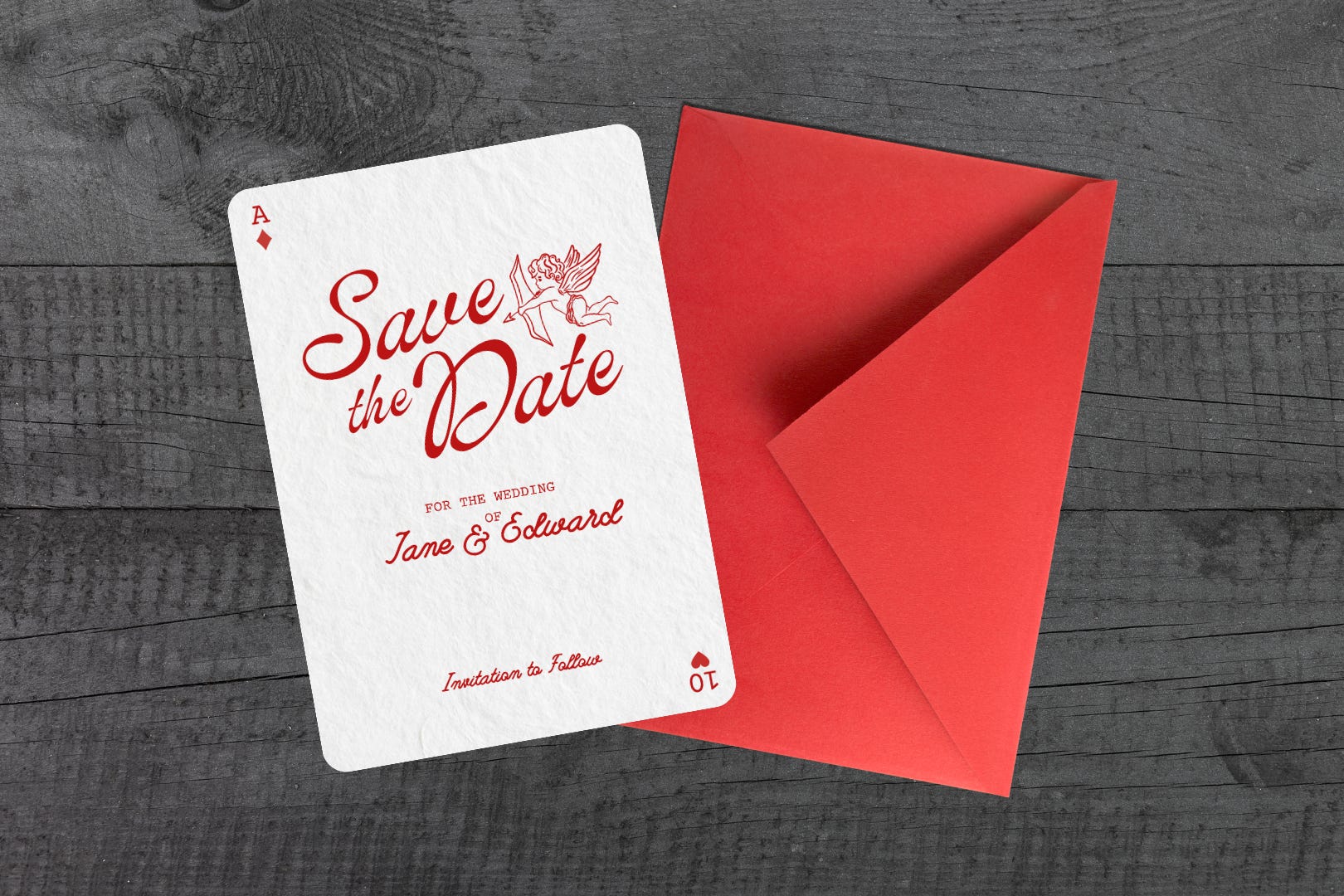
This routine replaces the “Double Happiness” symbol with a “Save the Date” card, allowing for playful, light-hearted teasing about commitment and “the big day”. It retains the bulletproof, self-working mechanics of the Count-Back Force but frames it within a comedy prediction plot.
The result is a funny, engaging, and memorable routine that leaves the couple with a custom-printed souvenir—and perhaps a gentle nudge toward the altar!
Additional Kicker Endings
These four tricks, while similar to the above routines in method, all include a kicker ending to enhance the overall magical effect.
Wedding in Wonderland 💒
Difficulty: ⭐⭐⭐ (Intermediate)
Duration: ⏱️⏱️ (3-5 minutes)
Setup Time: 🎯🎯 (Moderate)
📋 Quick Reference:
Effect Type: Full Deck Location & Production Effect
Audience Size: Close-up/Parlour
Reset Time: Moderate
Key Moves & Principles: Christ Force, Double Undercut, Two-Card Catch
“Wedding in Wonderland” is another charming, romantic card routine that integrates the familiar nursery rhyme of “The Queen of Hearts” into a magical location effect, which then segues into a Royal Flush production sequence. Designed specifically for weddings and engagement parties, it turns a simple “compatibility test” into a strong piece of storytelling magic.
It begins by proving the couple is perfectly suited (finding the King and Queen of Hearts) and builds into a visual series of card productions—representing the stolen tarts and the knave—before culminating in a Royal Flush finale. It is not technically challenging, relying on timing and narrative rather than on difficult sleights, making it a reliable crowd-pleaser for any romantic occasion.
Loved Eightfold
Difficulty: ⭐⭐⭐ (Intermediate)
Duration: ⏱️⏱️ (3-5 minutes)
Setup Time: 🎯🎯 (Moderate)
📋 Quick Reference:
Effect Type: Packet Trick
Audience Size: Close-up/Parlour
Reset Time: Moderate
Key Moves & Principles: Under-Down Deal
“Loved Eightfold” is a sophisticated location effect that elevates a mathematical principle into a piece of philosophical theatre. By combining the Count-Back Force with the Under-Down Deal, you guide a couple through the eight ancient Greek types of love—from Eros (passion) to Pragma (enduring commitment). ❤❤❤❤❤❤❤❤
The routine culminates in two distinct climaxes: the impossible reunion of the King and Queen of Hearts, followed by the revelation that the discarded cards have arranged themselves into a perfect numerical sequence (Ace through Eight), mirroring the script’s poetic progression.
Soulmates in the Snow 👰🤵🌨
Difficulty: ⭐⭐⭐ (Intermediate)
Duration: ⏱️⏱️ (3-5 minutes)
Setup Time: 🎯🎯 (Moderate)
📋 Quick Reference:
Effect Type: Packet Trick
Audience Size: Close-up/Parlour
Reset Time: Moderate
Key Moves & Principles: Under-Down Deal
“Soulmates in the Snow” is a highly romanticised adaptation of Dean Dill’s modern classic, “Blizzard”. Unlike the original, which focuses on a single card prediction, this version transforms the effect into a test of destiny for the bride and groom.
A freely named card (e.g., Seven of Hearts) is lost in the deck, yet the couple manages to find it. The true miracle happens when they locate its perfect soulmate (Seven of Diamonds) immediately next to it. For the finale, you reveal that this outcome was inevitable—because every other card in the deck is completely blank! This routine combines a bold method with a powerful narrative: when you find “the one,” everyone else simply fades away.
Snowblind ❄
Difficulty: ⭐⭐⭐ (Intermediate)
Duration: ⏱️⏱️ (3-5 minutes)
Setup Time: 🎯🎯 (Moderate)
📋 Quick Reference:
Effect Type: Packet Trick
Audience Size: Close-up/Parlour
Reset Time: Moderate
Key Moves & Principles: Under-Down Deal
“Snowblind” is a streamlined, packet-trick variation of Dean Dill’s classic effect, “Blizzard”, designed specifically for couples. It strips away the need for complex deck switches or dedicated decks, offering a “love ritual” that is both practical and deeply deceptive.
In this routine, the bride and groom use a significant date to generate a random number. Through a “He loves me, he loves me not” elimination process, they isolate the King and Queen of Hearts. The true kicker comes when the remaining cards—representing all other romantic options—are revealed to be completely blank, proving that when you find “the one,” everyone else simply fades away.
It relies on a simple false shuffle and a cleverly disguised force, making it an elegant, meaningful, and surprising routine for weddings.
Star Sign Soulmates ♈♉♊♋♌♍♎♏♐♑♒♓
Difficulty: ⭐⭐⭐ (Intermediate)
Duration: ⏱️⏱️ (3-5 minutes)
Setup Time: 🎯🎯 (Moderate)
📋 Quick Reference:
Effect Type: Packet Trick
Audience Size: Close-up/Parlour
Reset Time: Moderate
Key Moves & Principles: Swivel Jinx Switch, Under-Down Deal
“Star Sign Soulmates” is a highly personalised routine that uses a couple’s own zodiac signs to “program” a packet of cards, creating a seemingly impossible coincidence.
After a series of fair shuffles and deals dictated by their star signs, they eliminate cards until only two remain—the King and Queen of Hearts. For a stunning kicker, the rest of the cards are revealed to have transformed into a flush of Hearts (or blank cards, depending on the variation), proving that “all you need is love.” ❤
This routine is perfect for table-hopping at weddings because it involves both partners equally and ends with a strong, romantic visual.
Additional Props
Finally, these two routines are made more interesting and memorable by incorporating additional props. For this reason, they’re probably better suited to more formal performance environments.
Lucky in Glove 🧤🃏🎲🎲🎲
Difficulty: ⭐⭐ (Easy)
Duration: ⏱️⏱️ (3-5 minutes)
Setup Time: 🎯🎯🎯 (Extensive)
📋 Quick Reference:
Effect Type: Full Deck Coincidence Effect
Audience Size: Close-Up/Parlour
Reset Time: Moderate
Key Moves & Principles: Self-Working Mathematical Force
“Lucky in Glove” is a sophisticated parlour routine that transforms a mathematical principle into a romantic “test of love”. By using a glove purportedly owned by the legendary Johann Nepomuk Hofzinser, you invite the bride and groom to channel the magical spirit of the “Father of Modern Card Magic”.
The routine utilises a thirty-two-card Piquet pack, a pair of dice, and a unique numerological procedure to generate a seemingly random “lucky number”. Through a series of fair eliminations, the couple defy the odds to reunite the separated King and Queen of Hearts—proving their love is predestined. This piece is ideal for formal wedding performances with ample table space, where you want to deliver a memorable, narrative-driven experience.
Raffle of Romance 🎟
Difficulty: ⭐ (Easy)
Duration: ⏱️⏱️⏱️ (7-10 minutes)
Setup Time: 🎯🎯🎯 (Extensive)
📋 Quick Reference:
Effect Type: Full Deck Prediction Effect
Audience Size: Close-Up/Parlour
Reset Time: Moderate
Key Moves & Principles: Self-Working Mathematical Force
“Raffle of Romance” is an engaging and interactive routine designed to be the centrepiece of a wedding performance. What started as a clever way to disguise the Count-Back Force using raffle tickets evolved into a playful parlour game that engages the entire room. Instead of a standard “pick a card” trick, this routine involves a tombola, a custom-made love token deck, and a beautifully wrapped wedding gift that sits in full view from the beginning. It combines comedy, romance, and a surefire self-working method to deliver a memorable experience for the newlyweds.
This routine is particularly valuable to professional wedding magicians because it plays well enough for a large reception crowd, unlike some intimate close-up tricks. It is also highly customisable. Furthermore, the couple keeps the custom deck and the gifts, turning the performance into a lasting souvenir (and effective marketing tool).
Wow, well that’s a lot of new magic to learn! I hope you enjoy practising and possibly performing some of these tricks over the festive period.
Yours Magically,
Marty
P.S. Phew, that took a lot of time and effort to write up. Please let me know if you notice any typos or mistakes in the various texts. I’ve done my best to avoid them, but a few might have slipped through.